Keeping History Above Water

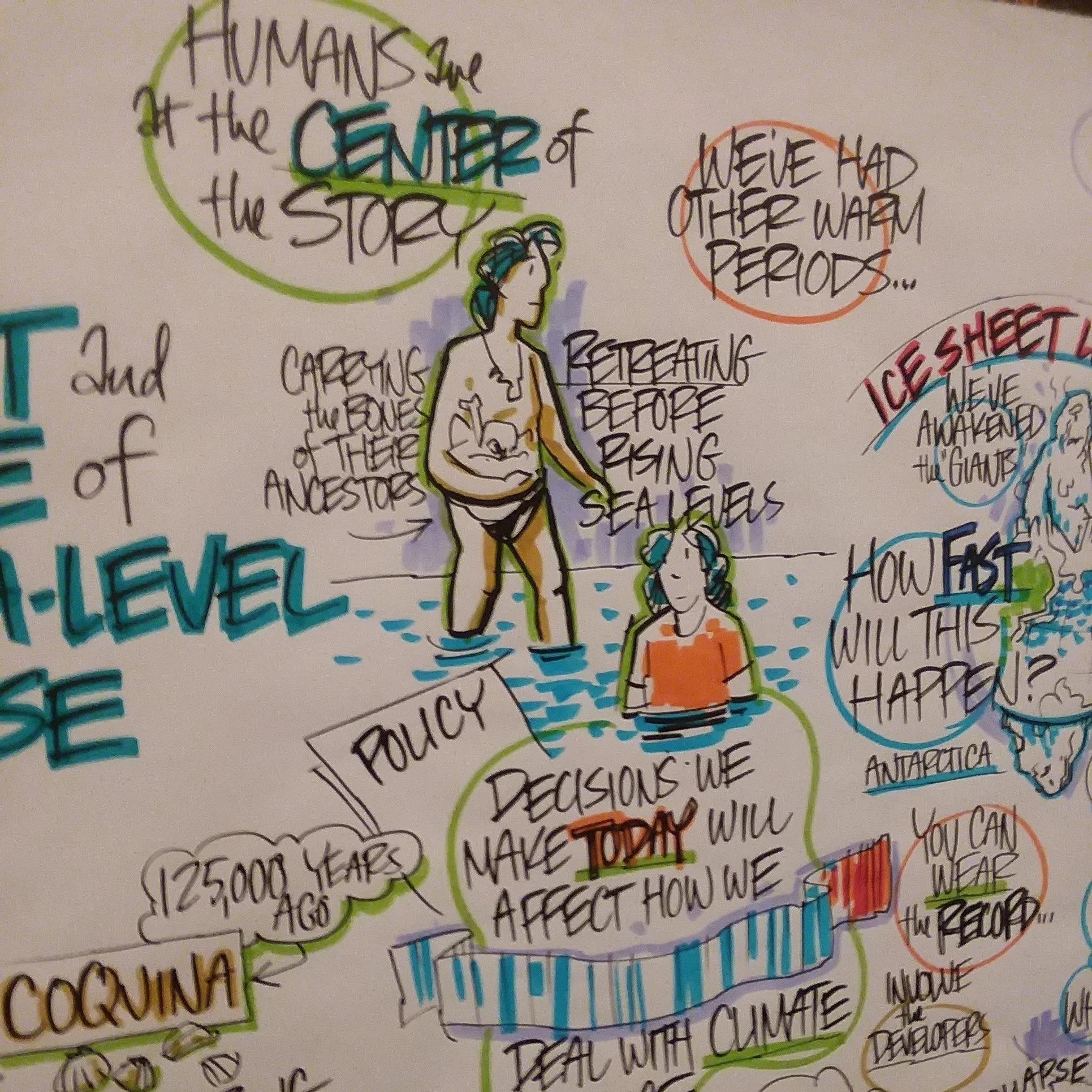
Images by Graphic Illustrator Jim Nuttle

How are Communities saving their Historic Neighborhoods and Landmarks from rising waters?

by Julie Ann Larry

Last week was both inspiring and depressing. I attended a terrific conference that brought together climate scientists, geologists, preservation professionals, government officials, and activists to discuss the threat of rising sea levels to historic buildings and sites around the world.

The conference kicked off during a violent thunderstorm that flooded city streets and gave attendees just a taste of the flooding that the beautiful old city of St. Augustine has been experiencing with greater frequency. I forded the flooded streets on Day One to hear journalist and author Jeff Goodell speak about his recent two month voyage to southwest Antarctica’s Thwaites glacier. It was well worth my wet feet! Mr. Goodell is a captivating story teller. He is a contributing editor at Rolling Stone magazine and wrote about his Antarctic journey in a recent feature. It’s worth a read.
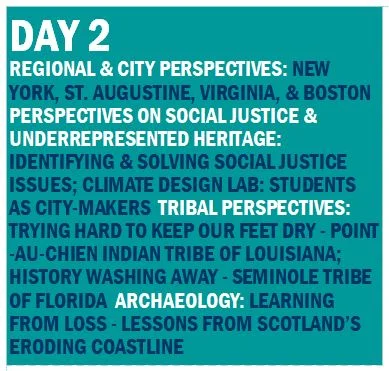
Day 2 Graphic.JPG

Over the next three days I learned more than I ever knew possible about how water behaves from geologists and storm water professionals. I listened to national security professionals describe the challenges of tackling this issue in today’s political climate and the current impact of sea level rise on our military bases. And I heard heartbreaking stories from community activists, like Elder Theresa Dardar of the Point-au-Chien Tribe in Louisiana, whose communities are rapidly changing due to rising sea levels and the human interventions that have exacerbated those impacts.

Honestly, I left the conference overwhelmed. Where can we begin and how can we make an impact? The general consensus of the scientists was that even if we did everything we can to lesson our impact on the warming of our planet today, we’ll still be feeling the impact of the past decades for decades to come. Maine, like many communities, is behind in planning for a changing climate. So what can we do? The first step is understanding what are the current conditions of properties that may be at risk and documenting those risks, whether it is utility connections or basement openings below flood level, loose materials that might be ripped off in high winds, or shady trees that can help cool homes in our increasingly hotter summers.
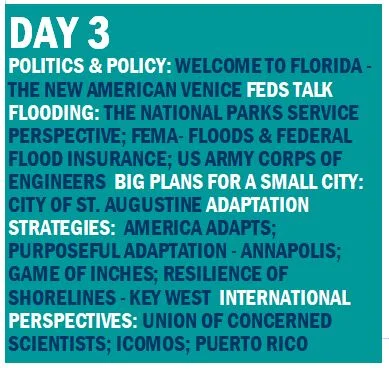
Day 3 Graphic.JPG

So this summer Greater Portland Landmarks is conducting the first survey of historic resources at risk from the impacts of climate change in the state. We have four summer interns that will undertake the survey. They have been generously funded in part by a grant administered by the National Park Service, Department of the Interior and matching funds from several Landmarks members. We hope next year to continue the the work by developing educational materials that we can share with homeowners and others interested in what they can do in their communities to prepare for the coming changes. Unfortunately some of that planning will be making tough decisions about what we cannot save.

In the meantime we’ll continue to advocate for fewer demolitions and more reuse of older buildings in greater Portland. Why? Because when it comes to the environmental impacts of building construction, reuse is almost always preferable to new construction. In particular, renovated buildings with fewer new materials have the potential to realize the greatest short-term carbon savings. Since most climate scientists agree that immediate-term action is crucial to staving off the worst impacts of climate change, reducing construction waste and recycling our existing buildings will help our community reduce our carbon footprint.

Conserving our historic resources isn’t going to solve our climate problems, but it can and should be part of the solution.

Images_Maps.jpg

Forest Ave. Matters

Forest Ave. Matters

As part of our National Preservation Month (and beyond) we are using social media to highlighting the 15 buildings proposed by the City of Portland to be designated as locall significant buildings. The designation includes a number of auto-related commercial buildings as well as buildings significant to the development of the Woodfords Corner neighborhood like Odd Fellows Hall and the former Deering fire station, now occupied by Big Sky Bakery. Find us on Instagram and Facebook using the hashtag #Forestavehillmatters along with the national hashtag #thisplacematters. We hope that you will follow along! We will add each image from social media on this page as the month unfolds. Add your Forest Ave memories in the comments below!

Forest Avenue has always been a critical transportation

Munjoy Hill Matters

May is National Preservation Month which happens to coincide with the reveal of the city’s proposed historic district on Munjoy Hill. One way that we are celebrating this month is by sharing photos and histories of houses on Munjoy Hill on instagram and facebook using the hashtag #munjoyhillmatters along with the national hashtag #thisplacematters . We hope that you will follow along! We will add each image from social media on this page as the month unfolds.

Landmarks supports designation of a Munjoy Hill Local Historic District with boundaries focused on the Eastern Promenade and North Street. These resources tell the story of the Munjoy Hill neighborhood’s development over a broad period of time and retain significant levels of architectural integrity. Munjoy Hill's historic buildings are significant features of the neighborhood's streetscapes and help make the area a desirable and attractive place to live, work and play. It is necessary to preserve the character defining buildings that reflect the neighborhood's development over a broad period of time and the role the buildings' residents played in the social and cultural history of the neighborhood, before more of the Hill's historic identity is lost. Read more about Landmarks’ position here.

All contemporary photographs are from Greater Portland Landmarks or the City of Portland.

All 1924 images are from the City of Portland’s 1924 tax photos which can be found on The Maine Memory Network.

Landmarks' Next Executive Director

Landmarks' Next Executive Director

To mark the first day of national Preservation Month (May 1), Greater Portland Landmarks’ Board of Trustees announced the appointment of Sarah Hansen as the organization’s next Executive Director. Sarah will start her post on June 17th to allow her to overlap with the long time outgoing executive Director, Hilary Bassett, who retires on June 30th.  Sarah joins the organization at an exciting and critical time for strong historic preservation advocacy in greater Portland as it faces unprecedented development pressure.

 Jane Batzell, chair of the search committee said, “we are ecstatic that Sarah will be Landmark’s next leader. Throughout the interview process she shared an invigorating passion for preservation and community engagement that was infectious.”

The Trade Show Files: The Unique Offerings of Historic Homes with Town & Shore Associates

The Trade Show Files: The Unique Offerings of Historic Homes with Town & Shore Associates

The 2019 Old House Trade Show is just one week away, so we’re sitting down with a few REALTORS® participating in the show to get their perspectives on working with historic homes—and to learn what buyers and homeowners might expect in the process of buying or selling an older home. Below, read our conversation with Town & Shore Associates, LLC, a local real estate brokerage and sponsor of the Old House Trade Show.

The Trade Show Files: Considerations When Selling and Renovating Your Older Home with Tom Landry

The Trade Show Files: Considerations When Selling and Renovating Your Older Home with Tom Landry

With the 2019 Old House Trade Show rapidly approaching, we’re taking a moment to chat with a few REALTORS® participating in the show to get their perspectives on working with historic homes—and to learn about what buyers and homeowners might expect in the process of buying, selling, or renovating an older home. Read our conversation with Tom Landry below, of Benchmark Real Estate and CornerStone Building & Restoration. Both Benchmark and CornerStone are Preservation Sponsors at Landmarks, and the Benchmark team will be joining us as a Corner Sponsor for this year’s show.

The Founding Women of Portland's Preservation Movement

The Founding Women of Portland's Preservation Movement

By Daphne Howland

 Women have been a critical force not only in saving key buildings but also in changing the city’s approach to its historic fabric.

 The American historic preservation movement owes much to women’s volunteer efforts, and the Portland area is no different. The effort often recognized as the first major preservation movement was Ann Pamela Cunningham’s campaign to save George Washington’s Virginia farm, Mount Vernon.

 Today we accept the importance of keeping George Washington’s home as a national treasure, but that wasn’t true in the 19th century when the farm’s future was in doubt. Cunningham formed the Mount Vernon’s Ladies Association, which includes a regent and vice regent from each state and oversees the farm to this day, after receiving a note from her mother in 1853 that read, “If the men of America have seen fit to allow the home of its most respected hero to go to ruin, why can't the women of America band together to save it?”

 “Of course, what we need to remember about women in preservation is that women have been crucial to the movement since the beginning in this country,” says Earle Shettleworth. “In Portland, there’s a long tradition of women playing pivotal roles in the preservation of our past. Probably the first person we would cite would be Ann Longfellow Pierce.”

Edith Sills, right, Bowdoin College Archives image no. 4317

The Trade Show Files: A Realtor's Perspective with Erin of Gardner Real Estate Group

The Trade Show Files: A Realtor's Perspective with Erin of Gardner Real Estate Group

With the 2019 Old House Trade Show just weeks away, we sat down with REALTORS participating in the show to get their perspectives on working with historic homes—and to learn about what buyers and homeowners might expect in the process of buying or selling an older home. Read our conversation with Erin Oldham below, who represents Gardner Real Estate Group, a long time supporter of Landmarks and sponsor of this year’s Trade Show.

Landmarks: How is the sales process different when working with an older home?

Erin: From the listing side, there is a bit more preparation including researching the provenance and story of the home.  When I walk through a home for the first time, I am very focused on documenting the unique features of the home as well as the upgrades in the kitchen/bathroom and all of the systems.  Showings work a bit differently as well: I present the story of the home to the buyers and point out the special features.  It is worth having buyers understand that beyond just purchasing a home, they could become part of the story of the home.  I believe knowing the story enhances the value of the home and also introduces the buyer into the world where stewardship of a home matters and contributes to long-term value.

The Trade Show Files: Ask the Experts

So you have an old house - now what?

A while back Greater Portland Landmarks invited five old house experts (Marc Bagala, Les Fossel, Julie Larry, Arron Sturgis, and Peter Taggart - bios after the conversation) to comment on how to prioritize your plan for any major work on your older or historic home. We asked them how to incorporate plans for sustainability and energy efficiency, how to stay on budget, how to prepare, and more. Here’s how they answered.

Peter Taggart, Marc Bagala, Les Fossel, and Julie Larry, will all be at the 2019 Old House Trade Show, March 30-31, where you can ask these experts more questions about your house. Get Tickets.

What is the first thing to consider?

Julie Larry: The first thing is to determine what are the important features of the house that should be maintained as part of the project, so that a home doesn’t lose its special character.

Peter Taggart: Research, to understand the history of the structure, the materials used, and the condition they’re in.

Arron Sturgis: A complete assessment of the home is the best way to increase appreciation and understanding of it. It provides the basis for knowing the condition, the materials within it, how it was built, and what changes were made over time.

Les Fossel: Ask yourself: do you have the resources (time, money, skills, energy and commitment) to take the project to completion? Don’t trust yourself on this, ask for experienced advice.

Marc Bagala: I want to be sensitive to the owners, their love for their home, and what they’re looking for. I try to design my work around that and their budget. My interview process is to ask a lot of questions.

How do you balance historic preservation with sustainability and energy efficiency?

The Green Book and Portland

The Green Book and Portland

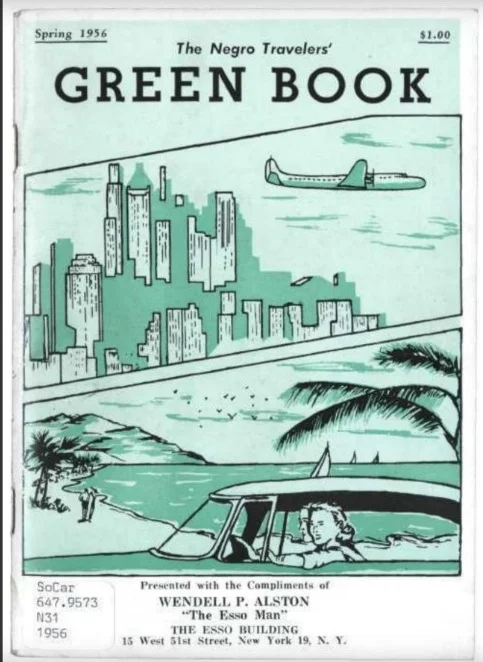
Did you know that Portland was included in this well-known guide book for African Americans travelling in the mid-twentieth century?

The guide book was originated and published by New York City mailman Victor Hugo Green from 1936 to 1966, during the era of Jim Crow laws, when open and often legally prescribed discrimination against non-whites was widespread. Although pervasive racial discrimination and poverty limited car ownership, the emerging African-American middle class bought automobiles as soon as they could afford to do so, but when travelling faced a variety of dangers and inconveniences along the road, from refusal of food and lodging to arbitrary arrest. In response, Green wrote his guide to services and places relatively friendly to African-Americans, eventually expanding its coverage from the New York area to much of the United States. He also founding a travel agency.