
On January 1, 1863, the Portland Daily Press wrote that President Lincoln "will proclaim freedom to all the slaves in the states now in open revolt and armed rebellion against the laws of the land," calling the Emancipation Proclamation "the most important event of the century." Portlanders read those words the day they were printed. The people of Galveston, Texas waited 908 days longer, until June 19, 1865, which we now celebrate as Juneteenth.
This Juneteenth, we honor the Black history rooted here in Portland. As we work to expand our inventory and highlight sites of important Black history, today we focus on the story of Green Memorial African Methodist Episcopal (A.M.E.) Zion Church at 46 Sheridan Street on Munjoy Hill.
The A.M.E. Zion denomination traces its origins to 1796, when Black members of the John Street Methodist Church in New York City established their own congregation after enduring open discrimination. Former members of the Second Parish (Congregational) Church similarly established the Abyssinian Religious Society in Portland in 1828 and built the Abyssinian Meeting House. Continuing this legacy of self-determination, in 1891 A.M.E. Zion charter members Moses Samuel Green and Ellen Odin petitioned their bishop to send a missionary to Portland. Green had been born into slavery in 1852, arrived in Portland in 1888, and became the wealthiest African American in the city. The congregation completed its permanent home on Sheridan Street in 1914. When the Abyssinian was dissolved in 1917, many of its parishioners became members of the A.M.E. Zion church.
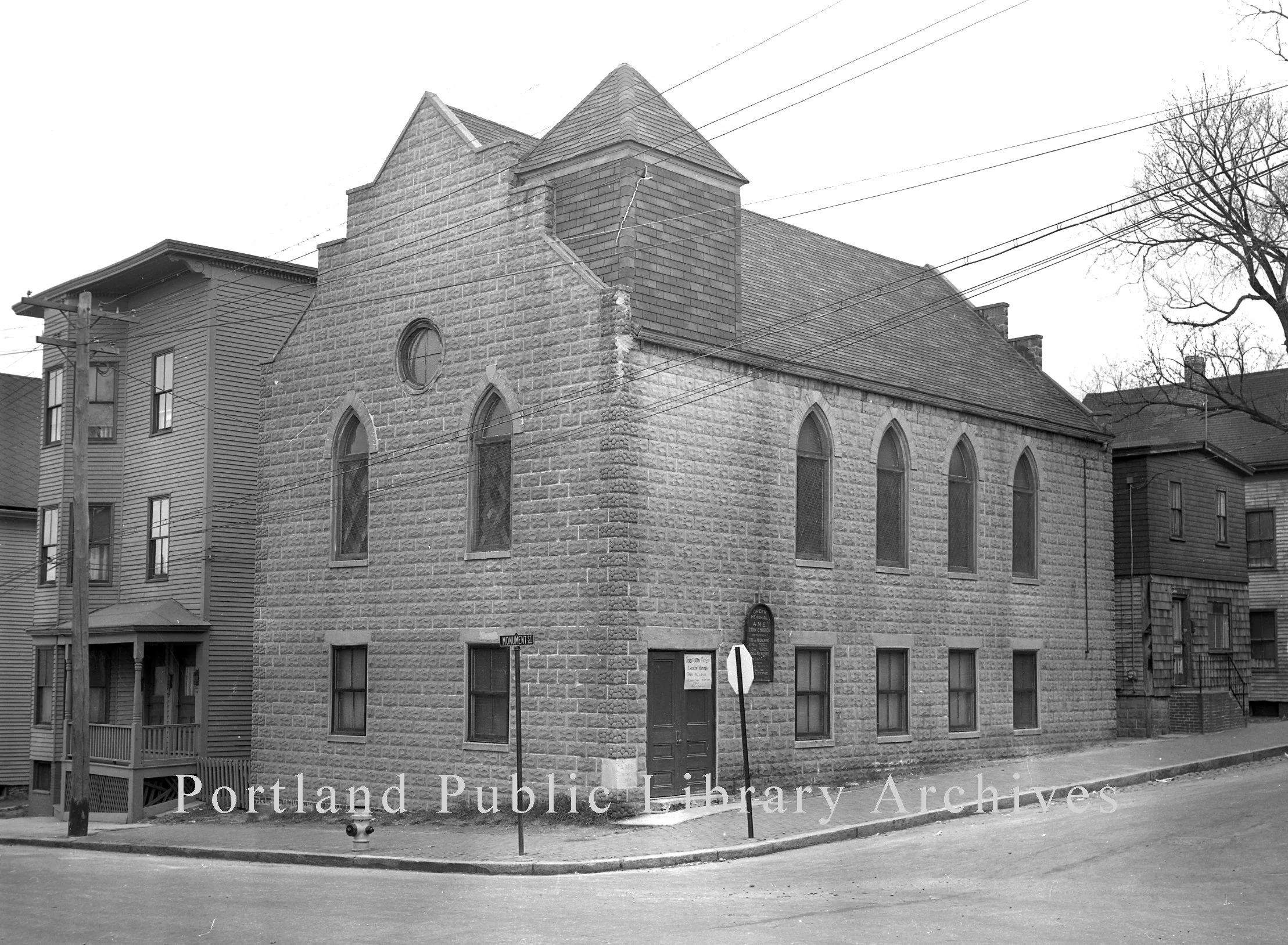
Image: "Green Memorial A.M.E. Zion Church, 1961" (1961). Businesses & Buildings - Portland Newspapers (Guy Gannett) Still Film Negatives. 187.
By mid-century the Green Memorial church was central to Portland's Black community. Women, following Ellen Odin’s lead, formed a Big Sister Circle to mentor young girls. Thursday night chicken dinners, scheduled on the one weekday many domestic workers had off, became a beloved fundraiser. A church bus carried families to annual Independence Day gatherings at Old Orchard Beach, Scarborough, and later Sebago Lake.
The church also served as a foundation for civil rights work. One minister pressured Maine's senators to support the 1918 Dyer Anti-Lynching Bill. Another traveled to the March on Washington in 1963. The building was listed in the National Register of Historic Places in 1973, the first in Maine recognized specifically for its significant African American history.
Green Memorial is still an active and important congregation today. As Reverend Kenneth Lewis said in 2018, "Sunday is the most segregated day in the United States. But not at the corner of Monument and Sheridan."