Hunting for Kit Homes in Greater Portland

Julie Ann Larry, Director of Advocacy, Greater Portland Landmarks

Explore the kit and catalog homes of the Oakdale neighborhood with our self-guided walking tour!

What is a Kit Home?

A kit house is a package of nearly all the materials (lumber, millwork, flooring, siding, roofing, gutters, piping, windows, hardware, lath, paints, etc.) you need to build a house (including the instructions!) that would be shipped to you from a mail-order company by train to your town. Home builders would then pick up the crates of materials at the local train station and assemble a home on their site. There were seven major kit manufacturing companies in the United States and a few smaller regional companies. Although records do not exist for all the companies, it is estimated that 500,000 to 750,000 kit homes were sold by the major manufacturers in the first half of the 20th century. The kit homes that we have been researching in Greater Portland were built generally 1908-1940, but kit homes were manufactured until the 1970s.
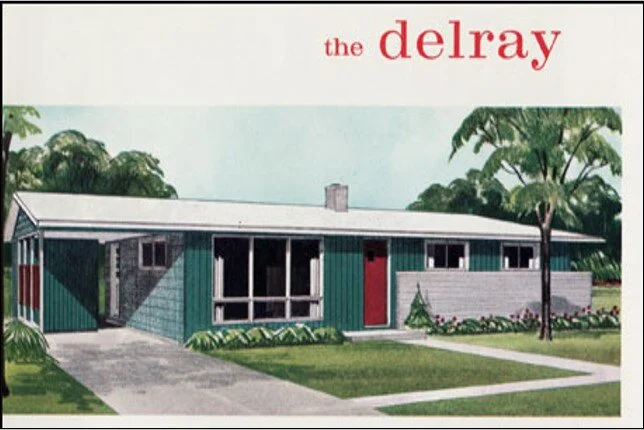
 
Kit home manufacturing lasted into the second half of the 20th century with manufacturers producing ranch homes influenced by the International Style’s ribbon windows and long low roofs. This example is The Delray from a 1960 Lewis Manufacturing Co.…

Kit home manufacturing lasted into the second half of the 20th century with manufacturers producing ranch homes influenced by the International Style’s ribbon windows and long low roofs. This example is The Delray from a 1960 Lewis Manufacturing Co. catalog, known as Liberty Ready-Cut Homes.


Pattern Books and Prefabricated Houses in the 19th Century

Kit home manufacturing and sales in the early 20th century grew out of a long history of sales and distribution of home plans and low-volume prefabricated housing materials. In the 18th and 19th centuries, books of plans were used by owners and builders to design and construct houses in the popular styles of the period. Asher Benjamin (1773-1845) of Connecticut and Andrew Jackson Downing (1815-1852) of New York were two well-known authors of pattern books . The Country Builder’s Assistant (1798) by Ashier Benjamin and Downing’s Cottage Residences (1842) and The Architecture of Country Houses (1850) provided examples of designs, advice, and how-to plans, elevations, and details for builders.

Maine’s lumber industry benefited from the state’s maritime trading routes and produced low volumes of prefabricated housing materials in the first half of the 19th century to ship to distant locales. In the 1840s and 1850s prefabricated building materials were shipped from Maine to the West Coast, where they wasn’t yet an active lumber industry. The Davis-Horton House in San Diego is an extant example of an early prefabricated house produced in Maine.

A detail from Asher Benjamin’s The Country Builder’s Assistant.

A detail from Asher Benjamin’s The Country Builder’s Assistant.

The Davis-Horton House (formerly known as the William Heath Davis House) built in 1850, is the oldest standing structure in Downtown San Diego. It serves as the home of the Gaslamp Quarter Historical Foundation and the Gaslamp Museum at the Davis-Ho…

The Davis-Horton House (formerly known as the William Heath Davis House) built in 1850, is the oldest standing structure in Downtown San Diego. It serves as the home of the Gaslamp Quarter Historical Foundation and the Gaslamp Museum at the Davis-Horton House. Originally, the house was one of several saltbox-style structures shipped from Portland, Maine, to San Diego, which had little wood for construction.

In the years leading up to the Civil War, lumbermen D.N. Skillings and D.B. Flint formed the Skillings and Flint Company of Boston and began marketing prefabricated panel structures. Both Skillings and Flint were involved in the lumber business and used the prefabricated building business to enhance their lumber interests. Flint was a partner in Flint and Hall, who had among mills in New York, Michigan and Canada, lumber mills in Bangor, Machias, and Calais, Maine. Skillings and Flint’s catalog designs targeted plantations in the West Indies, railroad companies in the West, farmers, and the Union Army.

A portable hospital offered by Skillings & Flint.

A portable hospital offered by Skillings & Flint.


20th Century Kit Home Manufacturing
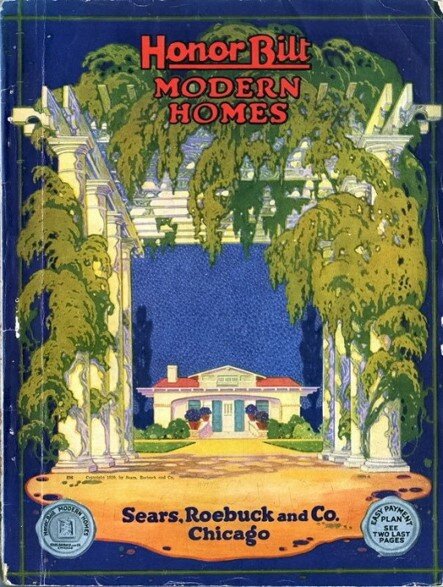
Perhaps the most well-known and researched 20th century kit home manufacturer is Sears, Roebuck & Co. Richard Sears, one of the founders, had been a lumber and coal dealer in Minnesota before founding the jewelry company that would grow to become Sears, Roebuck & Co. in Chicago. The mail-order company sold hardware, millwork, roofing materials, and paints and stains along with household and clothing items. Sears’ building materials department was nearly closed in 1906 from lackluster sales, but began to flourish when the company turned to packaging their building materials into home packages. With their new success, the company acquired lumber mills in Mansfield, Louisiana and Cairo, Illinois, as well as a millwork plant in Norwood, Ohio.  From 1908–1940, Sears, Roebuck and Co. sold about 70,000 - 75,000 homes through their mail-order Modern Homes program. In 1920 their Cairo plant alone was producing 250 houses a month.

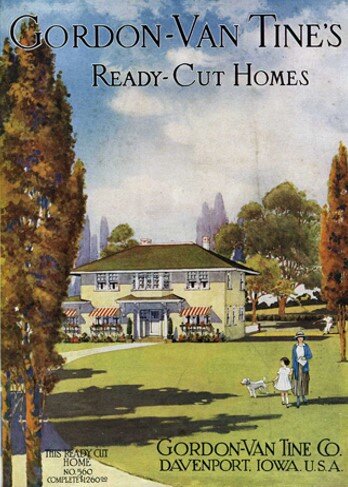
Less well-known is the Gordon-Van Tine Company. Gordon-Van Tine was established in 1907 as a building materials distributor in Davenport, Iowa. It was an outgrowth of U.N. Roberts, a lumber mill and mail-order building supply company founded in 1866. Its location in Davenport, Iowa is strategically situated on the Mississippi River and a major railroad line. Lumber was supplied to the company’s mill via the river and then freight was distributed by rail to the East and West coasts. Sears contracted with Gordon-Van Tine for five years until purchasing their Norwood, Ohio millwork plant in 1912. In 1916 Gordon-Van Tine began offering their own line of Ready-Cut houses. Then in 1919 they contracted with Montgomery Ward to manufacture that company’s new line of kit homes.

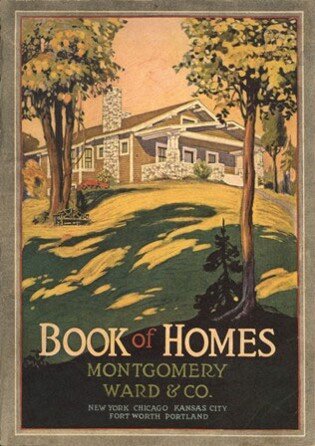
Like their mail-order competitor Sears, Roebuck & Co., Montgomery Ward was located in Chicago and offered household goods and clothing delivered by mail. They also began selling building materials, lumber, hardware, and house plans before World War I. However they did not have the manufacturing infrastructure to design, cut, and package an entire house. So in 1919 they contracted their kit house manufacturing to Gordon-Van Tine and began selling the homes under the Wardway Homes name. As a result, many of their homes are identical to those offered by Gordon-Van Tine.

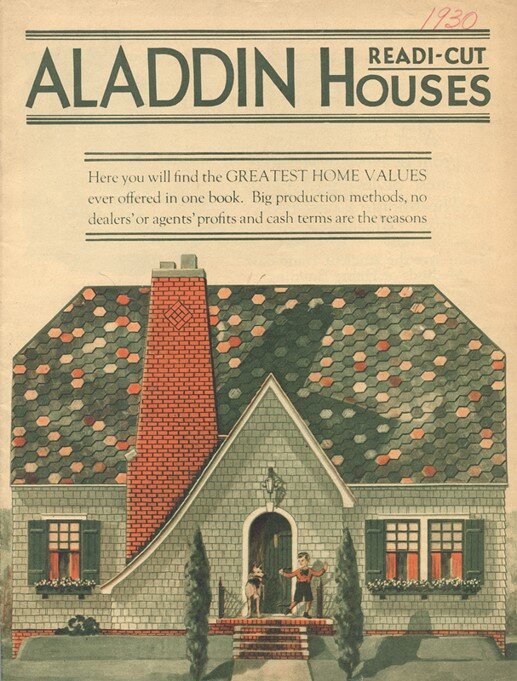
Other less well-known manufacturers were Harris Bros. Company of Chicago; Ray H. Bennett Lumber Co., of North Tonawanda, New York; Lewis Manufacturing of Bay City, Michigan; International Mill and Timber of Bay City, Michigan which sold homes under the name of Sterling Systems Homes; and Aladdin Company, also of Bay City, Michigan. Aladdin Company was one of the longest lived and most successful kit home companies. Founded by brothers William and Otto Sovereign in 1906, the company remained solvent and family-owned until it shut its doors for the last time in 1981.

IMG_1208.JPG
IMG_1211.JPG

Some kit manufacturers sold more than just houses - you could also by a garage, a barn, chicken coop, or even an outhouse! Montgomery Ward, Sears, and Gordon-Van Tine sold a variety of sheds, barns, and other agricultural outbuildings. As Montgomery Ward advertised, “Good cattle should have good housing too!”

Identifying Kit Homes

Many Kit homes can be identified by the presence of stamped lumber. Labeling systems were used by manufacturers to aid in the dwelling’s assembly. Different manufacturers used different labeling systems, and some manufacturers used multiple labels, …

Many Kit homes can be identified by the presence of stamped lumber. Labeling systems were used by manufacturers to aid in the dwelling’s assembly. Different manufacturers used different labeling systems, and some manufacturers used multiple labels, making identification of a manufacturer challenging.

How can you identify a kit house? It can be challenging. Although a few manufacturers retained their sales records and made them available to the public, not all manufacturers maintained or retained records of their products’ distribution. Nearly all sales records from the major manufacturers, including Sears, Roebuck Co., have been lost, but Aladdin's sales records are available in an archive at Central Michigan University.

However, kit homes themselves may retain some references to their pre-fabricated past. Wood framing was variously stamped, marked, or labeled by each manufacturer.  The image to the right shows an example of the markings that maybe found in basements, attics, or walls of kit houses. In addition to framing marks, other materials may identify a kit house like Sears Roebuck Co.'s  Goodwall 4x4 sheetrock and plumbing fixtures marked "R or SR" on the underside or corner of fixtures. But some of these materials were also sold separately in catalogs and may not be a definitive way to identify a kit house.

This dwelling on Ludlow Street in Portland isn’t a kit home, but was likely built using standardized plans from companies like Standard Homes Co.

This dwelling on Ludlow Street in Portland isn’t a kit home, but was likely built using standardized plans from companies like Standard Homes Co.

The dwelling to the left on Ludlow Street in Portland is remarkably similar to this dwelling offered by Standard Homes, a building plan company that sold plans to builders and owners for nearly 60 years.

The dwelling to the left on Ludlow Street in Portland is remarkably similar to this dwelling offered by Standard Homes, a building plan company that sold plans to builders and owners for nearly 60 years.

A big challenge to identifying kit houses is the similarity between various kit houses and between kit houses and some houses built with catalog building plans. This Tudor inspired dwelling on Ludlow Street near Deering High School is likely an example of Standard Homes “Fulton”, an English Cottage design with three bedrooms. The Standard Homes Company was established in 1917 by A. Gales Johnson and produced building plans for builders and owners for nearly 60 years.

Similar Homes.JPG

Although many company catalogs have been reprinted or are available online, because some companies used the same mill suppliers, identifying a kit house from the exterior can be challenging. Many designs and plans can look the same. Above are three similar homes by three manufacturers. They are distinguishable by minor exterior details like arched doorways or the chimney design.


Kit Homes in Greater Portland

Using deed research, historic photos, and manufacturers catalogs Landmarks has identified nearly two dozen possible kit homes in Greater Portland. The Oakwood Heights neighborhood near USM, formerly part of the former Deering Estate, was subdivided in 1923 by Thomas Sanders, a local developer who lived in Fessenden Park between Deering and Brighton Avenues. Sanders was also responsible for the development of Bedford Park, between Bedford Street and I-295. While Sanders sold off lots, he also built several homes on speculation. Between March of 1923 and mid-1924, when the City of Portland documented the neighborhood, then still under construction, as part of their tax assessment work, about two dozen homes were already built within the development. Our research identified several houses in Oakwood Heights that might possibly be kit houses and we undertook some additional research on several of the properties to identify which manufacturers and models might be present in the neighborhood. It appears that Sanders utilized both building plans and kit houses from several manufacturers to quickly build out his neighborhood.

When this dwelling on Woodmont Street in Portland went on the market several years ago it had a remarkably intact kitchen with a built-in eating nook and original kitchen cabinetry.

When this dwelling on Woodmont Street in Portland went on the market several years ago it had a remarkably intact kitchen with a built-in eating nook and original kitchen cabinetry.

Sears House_Kenwood Street.JPG

This Oakwood Heights house at 14 Kenwood Street appears from the exterior to be an example of a Sears "Glen Falls" model house. Slightly altered with an infilled porch, the house was first occupied by Ralph Mahoney, an orthopedic doctor and his family. In the 1930 US Federal Census, the Mahoney house was valued at $13,000.

Beyond Oakwood Heights we have identified kit houses in South Portland, Falmouth, Brunswick, and other Portland neighborhoods. Using information on representatives that signed Sears’ mortgages we verified this Sears “Maplewood” model house on Bradley Street in Portland. The house was built in 1932 at a cost of $6,500 for Charles and Gladys Flight. Charles was an accountant at Great Atlantic & Pacific (A&P) Tea Co. The couple left Portland in 1950 and moved to Japan. It appears to be a mirror image of the model house.

A Sears kit home on Bradley Street in Portland.

A Sears kit home on Bradley Street in Portland.

The Maplewood model by Sears.

The Maplewood model by Sears.

It is likely that there are other kit homes in southern Maine. We know that there are two purported Sears kit homes on Route 302 in Bridgton, a Sears house in Saco, and there are likely more kit homes that have not yet been surveyed and identified in subdivisions from the 20s, 30s, and 40s in our communities. Greater Portland Landmarks hopes to identify additional homes as we continue to survey buildings in suburban Deering and neighborhoods in surrounding communities, and we hope that homeowners will come forward to help us identify other potential kit homes!

Landmarks Recommends: Julie Larry's Favorite Books

Looking for something new to read? We’ll be sharing some staff favorites on the blog over the next few weeks. Sadly the library is currently closed, but titles are available from online retailers - and you can order online and have titles shipped from many of our local bookstores. Enjoy, stay safe, and #stayhome!

Julie Larry, architect, architectural history guru, and Director of Advocacy at Landmarks, shared a list of her favorite books related to historic preservation - and others just for fun!

Field Guide to American Houses by Virginia McAlester: This is my bible, my older copy is held together by duct tape. This new edition delves deeper into post World Ward II architecture.

Houses Without Names_Hubka.JPG

Thomas C. Hubka is best know for his book Big House, Little House, Back House, Barn . In Houses Without Names, Hubka examines more contemporary vernacular architecture for patterns and trends that tell the story of modern living. 

Want to learn more about kit and catalog homes from the early 20th century?  117 House Designs of the Twenties and Best Homes of the 1920s are two great sources.

Turn of the Century House Designs & Beautiful Bungalows: My favorite period of architecture extends from the late 1880s into the first decades of the 20th century and I love a good floor plan. 

The Irish of Portland Maine: by Matthew Jude Barker. Much of my research over the last ten years has been centered around the impact of immigration on Portland's neighborhoods. Portland's Irish community has had a large role in shaping today's city, including many of its iconic landmark buildings. 

Places of the Soul_Day.JPG

Places of the Soul: by Christopher Day is one of the books that propelled me towards a career in historic preservation.  As a designer it's important to pay attention to the qualities of spaces to which we are naturally attracted, and when we build new, to incorporate those qualities in order to create buildings that we will want to preserve in the future. 

Like photography? Some histories can be dry, but these two books illuminate history with beautiful photographs”  A Day's Work: A Sampler of Historic Maine Photographs 1860-1920 and City by the Sea: A Photographic History of Portland, Maine.

Essential Louisiana Cookbook.JPG

Essential Louisiana Cookbook: Because when I'm sheltering-in-place I cook comfort food, and when I cook comfort food I want something from New Orleans, my second home. 

Any of Bruce Robert Coffin's books featuring Portland's Detective Byron. I love to read mysteries set in Maine, and this series is set in and around Portland featuring many familiar places. The former Rufus Deering lumberyard, currently under redevelopment, features prominently in the latest Detective Byron novel Within Plain Sight

Artists: Preservers of Place—and Portland

Stephen Etnier, Union Station oil on canvas, 1941, 28 by 36 inches Photo Jay York, courtesy Barridoff Galleries

Stephen Etnier, Union Station
oil on canvas, 1941, 28 by 36 inches
Photo Jay York, courtesy Barridoff Galleries

Guest post by Carl Little

When my brother David and I embarked on Paintings of Portland, our third book collaboration, we went looking for images that represented the city in all its geographic and architectural diversity. We wanted to tell a story of the city’s evolution from multiple perspectives, with images that would present a vibrant changing city.   

An especially resonant image is Stephen Etnier’s painting of Union Station (above). The dark palette serves as a kind of somber foreshadowing of this famous structure’s ill-fated end, its demolition in 1961. As historian Joseph Conforti notes in Creating Portland, “Images of Union Station have served as more than a memorial to past grandeur; they have been a summons to safeguard the architectural heritage that distinguishes Portland as a place.” The loss of that mighty and handsome train station led to the creation of Greater Portland Landmarks. 

Robert Solotaire, Passage oil on paper, 1990, 13 by 29 inches Photo Jay York, courtesy Barridoff Galleries

Robert Solotaire, Passage
oil on paper, 1990, 13 by 29 inches
Photo Jay York, courtesy Barridoff Galleries

Passage, the title of Robert Solotaire’s painting of the Franklin Street Arterial, probably refers to this prominent roadway. Yet it also brings to mind the urban renewal that erased a Bayside neighborhood in order to insert this corridor—an event immortalized in Peter Kilgore’s poem “Portland Renewal Authority” recently reprinted in his collected poems

Sam Cady, Tower Spire, Munjoy Hill oil on cut-out canvas mounted on wood, 2008, 18 by 12 inches Courtesy Greenhut Galleries

Sam Cady, Tower Spire, Munjoy Hill
oil on cut-out canvas mounted on wood, 2008, 18 by 12 inches
Courtesy Greenhut Galleries

Other landmarks survive and continue to be historic touchstones. We included several images of the Portland Observatory, among them a shaped canvas rendering by Friendship-based painter Sam Cady, who was inspired by a photograph of the building taken by Bruce Brown, long-time Portland resident and a pillar of Maine’s contemporary art scene.  

Equally engaging is Alison Rector’s The Original Portland Public Library, in which sunlight casts a dramatic shadow across the Romanesque Revival structure designed by Francis H. Fassett. Philanthropist James Phinney Baxter built the library as a gift to the city in 1882. Today some of its interior has been re-imagined by the VIA advertising agency. 

Alison Rector, The Original Portland Public Library oil on linen, 2016, 10 by 14 inches Photo Jay York, private collection

Alison Rector, The Original Portland Public Library
oil on linen, 2016, 10 by 14 inches
Photo Jay York, private collection

We could have included a whole section of images of the Custom House on Fore Street but settled on Marsha Donahue’s light-filled watercolor of the blended Second Empire/Renaissance Revival-style building, constructed in 1867-1872. Likewise, if room had allowed, we would have featured more than one of C. Michael Lewis’s stunning architectural details painted as part of a scavenger hunt for Greater Portland Landmarks in 1993. The visage of Justice, looking down over the entrance to the Cumberland County Courthouse on Federal Street, had to suffice to represent this fun project.  

Marsha Donahue, US Custom House, Portland, Maine watercolor, 2010, 28 by 22 inches Collection Karen Sulzberger and Eric Lax

Marsha Donahue, US Custom House, Portland, Maine
watercolor, 2010, 28 by 22 inches
Collection Karen Sulzberger and Eric Lax

C. Michael Lewis, Justice acrylic on board, 1993, 16 by 24 inches Collection Ted and Lucinda Hart

C. Michael Lewis, Justice
acrylic on board, 1993, 16 by 24 inches
Collection Ted and Lucinda Hart

Joel Babb, Monument Square, Portland, Maine oil on linen, 2014, 28½ by 32 inches Private collection, courtesy Greenhut Galleries

Joel Babb, Monument Square, Portland, Maine
oil on linen, 2014, 28½ by 32 inches
Private collection, courtesy Greenhut Galleries

A number of artists have painted the city from an elevated prospect. Joel Babb took photographs of Monument Square from the offices of the Pierce Atwood law firm in developing his extraordinary bird’s-eye view of the heart of the city, that gathering place for protests, festivals, and the Wednesday farmer’s market. In the painting we look over the shoulder, as it were, of Our Lady of Victories, Portland’s Soldiers and Sailors Monument commissioned by the city in 1872 to memorialize the residents of the city who died in the Civil War. The bronze statue was created by Franklin Simmons (1839-1913), who also designed the statue of Henry Wadsworth Longfellow at the other end of Congress Street.  

Alice Spencer, Portland Zoning Map #2 acrylic on paper on board, 2006, 8 by 10 inches Courtesy Greenhut Galleries

Alice Spencer, Portland Zoning Map #2
acrylic on paper on board, 2006, 8 by 10 inches
Courtesy Greenhut Galleries

Perhaps no image in the book reflects the changing city better than Alice Spencer’s Portland Zoning Map #2. The artist was prompted to paint her zoning map series by visits to the Planning Office at City Hall when she served on the Portland Public Art Committee. Spencer is the founder of TEMPOart, a public art nonprofit that brings temporary site-specific art installations to Portland neighborhoods and urban sites.  

“As you look through this book,” David and I wrote in the foreword to Paintings of Portland, “consider the changing visual dynamics of Maine’s largest city, its growth and development.” We also encouraged our audience to “reflect on the ways in which Portland has been, and continues to be, a tried and true source of inspiration for artists of all aesthetic stripes.” In the act of painting, artists are preservers of place.   


Carl Little is the author of numerous books on Maine art and artists. He and his brother David Little have collaborated on three books: Art of KatahdinArt of Acadia and Paintings of Portland. 

Discover the story of your historic home

Screen Shot 2020-03-20 at 12.18.00 PM.png

If you’re stuck at home social distancing and looking for something to do, why not research the history of your house? Many of the documents you need are accessible online, and when you’re done you can even apply for a Historic Property Marker from Landmarks!

Start with the house itself. Gather what you know about the house – how old is it? Did previous owners leave you any information? Was it significantly altered? What style is your house? You can use our style guide or one of many other online resources to help identify domestic architecture style, like this one.

Many buildings were built based on plans in architectural publications or catalogues in the 19th and early 20th century. In the 19th century, building books by Asher Benjamin and Andrew Jackson Downing were very popular, and many of their titles are freely available to browse on Google Books or Archive.org.  The most well-known of the 20th century catalogues are those advertising the Craftsman kit homes sold by Sears, Roebuck and Co. For more information on these kit homes click here.

You can start tracing the history of your home’s owners using a deed search. Most counties in Maine allow you to search for deeds online – here’s the online search for the Cumberland County Registry of Deeds.

Digitized deed from the Cumberland County Registry

Digitized deed from the Cumberland County Registry

Start with your deed and trace the ownership history by noting the seller’s name and the legal description of the property. Each deed will usually reference an earlier deed, allowing you to trace the ownership history back in time. Write down the Book and Page of the deed from when the seller purchased the property. Next search for the seller’s deed of purchase and note whom they bought it from, working your way back to the first deed that lists the purchase of land AND buildings, then you've probably found the original owner! 

Some towns publish an ownership history in their assessor database, including owner name and the Book and Page of the deed in the Registry of Deeds (you can find your town’s assessor database on your town's website, or by googling). This information can help you find earlier deeds.

A page from the 1850 US Census

A page from the 1850 US Census

Next, learn more about your home’s previous occupants. You can search for previous owners in US Census records, vital records, and local directories to learn more about their families and occupations. Because Census and City Directory records include addresses, you can confirm it’s the correct person and learn what they did while they lived in your house. You can also access marriage and death records, which can sometimes give you a deeper understanding of the occupants of your house. Did they buy the house the year they were married? Did they purchase it from the descendants of the previous owner after he died? 

Ancestry.com is a great way to search these records if you have access. FamilySearch.org provides free access to all Census records and some other local records if you make a free account. FindAGrave.com is another resource for learning about your home’s occupants. Although less extensive than others, this free database has vital information about the people whose graves have been recorded, and in some cases includes photographs and short biographies.

If your building is substantial in size and style, it might have been designed by an architect. If you are fortunate enough to learn the name of the architect that designed your building, there are several biographical sites with information on prominent local architects:

1924 Tax Record photo of 270 Brackett Street

1924 Tax Record photo of 270 Brackett Street

You can also discover more about your house through images and maps. If you live in Portland, search for your address on Maine Memory Network to see what it looked like when it was photographed for the 1924 tax records, a good way to track how your home has changed over the years. Residents of other towns can check to see if your local library or historical society has photographs available online.

Searching for your house on a map can show how your neighborhood developed, if the footprint of your building changed, and sometimes can even show you past uses of your building. Maps available online include:

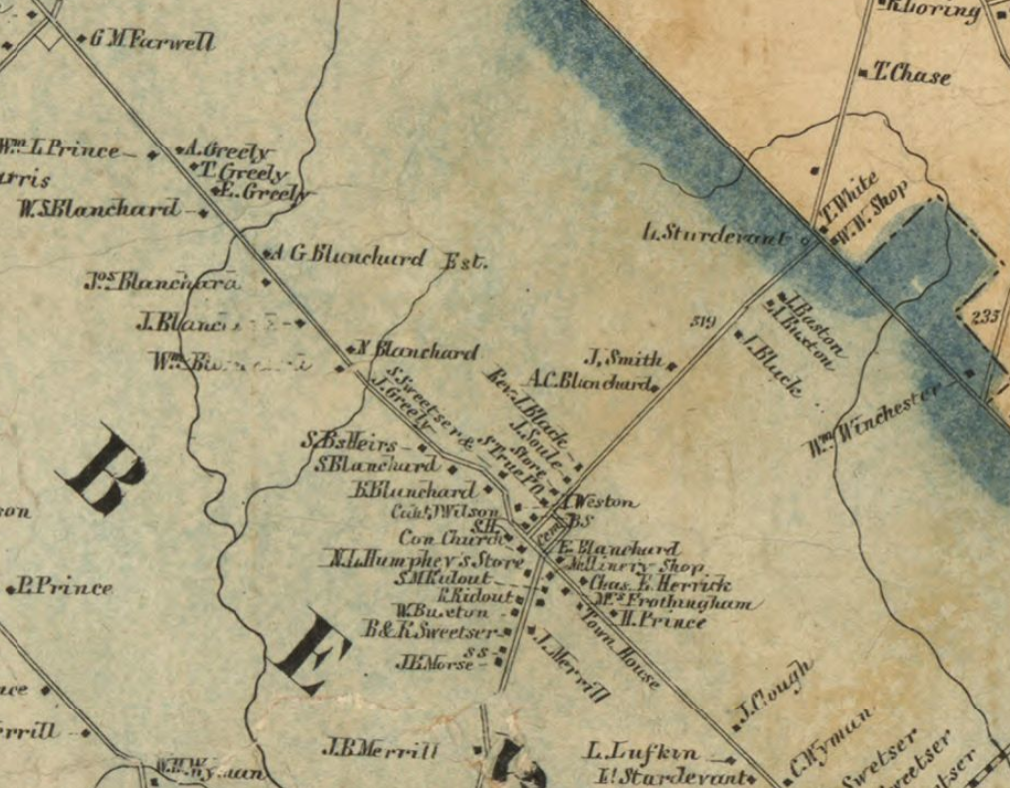
Cumberland Center in the 1857 Map of Cumberland County

Cumberland Center in the 1857 Map of Cumberland County

Once you know more about your home’s occupants and how your home has changed over time, you can start to situate the story of your house into a larger historical context. Learning about the development of your town or neighborhood can help you situate the context in which your house was built. Was it one of the first homes in the area? Or was it part of a development boom? Consult local history books about your neighborhood or town, like Portland or Deering. Many towns also have local history resources available online, including South Portland, Cumberland, Falmouth, and Portland - try checking the website of your local library or historical society. The Digital Maine repository contains a multitude of local history records.

Thinking about the wider history of the state and the country – statehood, war, economic booms, and recessions - can also help you tell the story of your home.  What has your home seen?

New+Markers+2019.jpg

As you research your house, compile the information you find in a document or a notebook so you can share it with future owners! And if you complete the research in this blog post, you’ll have all you need to get a Historic Marker from Landmarks to display.

Women-designed homes of Portland's Golden Age

By Alessa Wylie and Kate Burch

Some of the grand homes of Portland's golden age were commissioned or designed by women—a notable feat in the 19th century, as women in Maine were not allowed to own property separate from their husbands until 1847!

161 Pine Street

161 Pine Street

Elizabeth McDonald House, 1882
161 Pine Street
Architects: Francis Fassett & John Calvin Stevens

161 Pine Street (detail)

161 Pine Street (detail)

Elizabeth Murray McDonald (1828-1906) of New York bought the lot at 161 Pine Street in 1881 and the following year commissioned this Queen Anne mansion. Elizabeth was a woman of considerable wealth. Her husband, John Grant McDonald (1802-1874), founded the first Fifth Avenue coach line and was very active in New York City real estate development. When John died, he left Elizabeth as the sole executor and heir to his fortune. It is not clear why the widowed Elizabeth chose to leave the family’s home on 42nd Street in Manhattan to move to Portland, but she remained at her 161 Pine Street home for the remaining 25 years of her life. Elizabeth’s son Grant and his wife Mary lived with Elizabeth at the Pine Street house until his Elizabeth’s death in 1906. He then sold the property and moved back to New York City.

208 Pine Street

208 Pine Street

Mary J. Eastburn House, 1891
208 Pine Street
Architect: Unknown

The house at the corner of Pine Street and the Western Promenade has an interesting story. It was built by Mary Eastburn, who bought the empty lot in 1890. Mary was the widow of Manton Eastburn, the much older husband she had married when she was 29 and he a widower of 54. Manton was the 4th Protestant Episcopal bishop of Massachusetts, a diocese that, at the time, included Maine, New Hampshire, and Rhode Island.

After 16 years of marriage, Bishop Eastburn died in 1872. His will declared that ‘whereas…my dearly beloved wife Mary J Eastburn is now afflicted with disease which unfits her both mentally and physically for the management and control, as well as for the enjoyment of property’, Mary would be placed in the care of guardians until such time as, in their judgment, she could assume responsibility for her own affairs. In the years after Manton’s death, Mary is listed as living at the Berkeley or the Vendome Hotels in Boston.

What happened to Mary for the 18 years following Bishop Eastburn’s death is a mystery, but in 1890 Mary buys the lot and builds her home at 208 Pine, so she must have regained control of her finances. She lived in the house with the same boarders for the next 15 years: Pamela Wyman, a single woman about her own age, and George F. Shaw, his wife, and son. Pamela and Mary must have been close - when Mary died in 1906 she left the house to Pamela Wyman.

Margaret Jane Mussey Sweat’s Victorian decor in the McClellan Mansion’s dining room

Margaret Jane Mussey Sweat’s Victorian decor in the McClellan Mansion’s dining room

McLellan-Sweat Mansion, 1801
107 Spring Street
Architect: John Kimball

The McLellan-Sweat Mansion, built in 1801 for shipping magnate Hugh McLellan, was purchased in 1880 by Lorenzo DiMedici Sweat, who lived here with his wife Margaret Jane. Margaret Jane Mussey Sweat completely renovated the interior of the Federal mansion, and her interior design work can be seen in her photograph collection (available from the University of New England’s Maine Women Writers Collection).

Margaret Jane Mussey Sweat

Margaret Jane Mussey Sweat

Margaret was a patron of the arts, as well as a poet, author, and journalist. She was New England’s first female book reviewer, and the founder of one of the first women’s literary clubs. An avid traveler and theatergoer, Margaret always opened her home to female artists, actors, and performers. She is also the author of the first sapphic novel in America, Ethel’s Love Life.

Margaret remodeled the interior of the McLellan Mansion in the Victorian style, including wallpaper, ornate carved wood mantles, and a Gothic ceiling in the dining room. Following the death of her husband in 1898, Margaret re-wrote her will to bequeath the mansion to the Portland Society of Art to become a museum, stipulating that no significant changes could be made to the exterior of the house or to her decor. In the 20th century, the Portland Society of Art (now the Portland Museum of Art) petitioned the court and received permission to remove Margaret’s additions and restore the 1801 home's interior to its original state. Many of the founding members of Greater Portland Landmarks worked on this project to recreate historically accurate Federal-style rooms.

Portland's Planning Board to vote Tuesday on Munjoy Hill Local Historic District

Greater Portland Landmarks strongly believes that the proposed Munjoy Hill Local Historic District is the most effective way to conserve the character of the neighborhood and accommodate public participation in a transparent review process that has proven successful in the West End, Parkside, Old Port, and Congress Street historic districts for thirty years. The proposed Munjoy Hill Local Historic District has emerged from a lengthy and inclusive public process. It meets the designation criteria in the city historic preservation ordinance and is consistent with the City’s comprehensive plan, which supports historic preservation as an integral part of the city’s planning strategy.

We urge the Planning Board to accept the historic preservation board’s proposal and recommend its approval by the City Council for the following reasons:

1. The Portland City Council tasked planning staff to pursue a historic district as part of a suite of land use strategies when it approved zoning changes in June of 2018. The proposed district is meant to work in tandem with the conservation overlay district established at the end of the moratorium, much as the India Street Local Historic District and Form-Based code work together to manage growth and change at the foot of Munjoy Hill.

2. The Munjoy Hill Local Historic District will not freeze the hill in time. As we have seen in other historic districts, new construction and alterations allow neighborhoods to grow and change as needed to meet contemporary needs. Since November the Historic Preservation Board has approved alterations at 34-36 North Street and 49 St. Lawrence Street, an alteration that will add a housing unit to an existing multi-family dwelling. They have also conducted preliminary reviews for alterations and additions at 24 St. Lawrence Street and 9 Howard Street.

3. Our historic neighborhoods are important city assets that should be maintained and enhanced. Along with our food scene, the physical character of the Old Port, West End and Munjoy Hill contribute to Portland’s appeal as a desirable place to live and visit. Portland’s Plan 2030 supports the stewardship of Portland’s historic, cultural, and architectural assets as integral to the City’s planning strategy and was widely supported in public feedback received during the plan’s creation. Design review for alterations and new construction within our historic neighborhoods ensures we will maintain the character that helps support our city’s economic vitality.

4. The preservation or reuse of historic buildings helps to fulfill the City’s comprehensive plan goals to adopt sustainable building and land use policies. Nationwide research studies have found that the re-use or rehabilitation of existing buildings offer significant environmental benefits over new construction. “The greenest building is the one that is already built.” Carl Elefante, FAIA

5. The historic district will preserve properties associated with underrepresented communities in Portland. The sites and neighborhoods that represent the cultural and social history of Portland’s minority communities deserve preservation. The proposed boundaries of the Munjoy Hill Local Historic District encompass properties that represent the social and cultural history of several underrepresented communities. Portland’s immigrant story has been preserved in part through the recent designations of House Island and India Street. But few properties associated with the city’s African American history have been protected, with the exception of the Abyssinian Meeting House and the Green Memorial A.M.E. Zion Church on Munjoy Hill. Some of Munjoy Hill earliest residents were African Americans connected to Portland’s maritime history. The neighborhood was later home to residents that came to Portland from the West Indies, Azores, and Cape Verde. Their homes, mostly centered around the northern end of Lafayette and Quebec Streets, deserve to be protected.

6. The public record indicates significant support in the neighborhood for the proposed district. Over 170 property owners, residents, and supporters have spoken out or written to the city in favor of the proposed district. Please see the attached list that summarizes the level of support for the historic district.

Summary List of Public Comment

Map of the proposed district

Planning Staff memo on the proposed district

City Staff analysis of historic district to city’s comprehensive plan

Western Prom Master Plan Likely to Move Forward

Rendering from the Western Promenade Master Plan

Rendering from the Western Promenade Master Plan

Tonight, the Historic Preservation Board is likely to approve the Western Promenade Master Plan. The Plan, developed by KZLA Landscape Architects and the City of Portland, with input from the public and the Friends of the Western Promenade, will preserve and rehabilitate this historic designed landscape.

Greater Portland Landmarks supports the proposed Master Plan for the Western Promenade. We commend the work of the Friends of Western Promenade, who worked closely with the City in commissioning the plan according to national and local historic preservation standards. The plan supports a wide range of community uses, such as family-oriented concerts and programs at the bandstand, play spaces, recreational uses, and an improved dog park.

The plan calls for increasing pedestrian connections between Valley Street and the Western Promenade with path improvements and stairs, restoring significant view sheds, the removal of invasive species, and the addition of interpretive elements. These projects will enrich the experience of this important historic park, and we look forward to seeing the Promenade’s future.

The Western Promenade was designed by the landscape architecture firm Olmsted Brothers in 1904, and was placed on the National Register of Historic Places in October 1989.

See the Master Plan here.

Press

Future of Portland's Western Promenade up for discussion, Portland Forecaster, June 29, 2019

Restoration, upgrades in works for Western Prom, Portland Forecaster, December 18, 2019

Valentine's Day Photo Contest

Take part in our first monthly photo contest by giving a valentine to a building! We’ve made some valentines for you to download and cut out, or you can just snap a picture with a building that deserves some love. Tag your pictures with @portlandlandmarks and #valentineforabuilding, and we’ll share them on our feed! Photo contest winners will also be featured in an issue of the Landmarks Observer.

The Activism of Frannie Peabody

By Kate Burch

At the First Parish Church on December 1, 1993, Frannie Peabody, an AIDS activist and one of the founders of Greater Portland Landmarks, gave the keynote speech for World AIDS Day:  “In this historic church, on this sacred ground, many clarion calls have been heard in the past decades. Come on, Portland! Wake up!! It’s time to act.”

Frannie Peabody in her home on Walker Street

Frannie Peabody in her home on Walker Street

Frances “Frannie” Peabody was born in 1903 in Washington, DC. She grew up in what was then the territory of New Mexico, where she developed a love of historic buildings. Her father worked for the government and as a teenager Frannie would guide his visitors from Washington through Santa Fe’s historic sites.

After graduating from Smith College in 1925, Frannie married Millard Peabody and moved with him to Hingham, Massachusetts. Frannie delighted in the area’s history and began to volunteer at the Historical Society while raising her four children. The Peabody family moved to Maine when Millard’s business, the E.E. Taylor Shoe Company, relocated to Freeport.

Frannie first volunteered, and went on to leadership roles, with many of Portland’s historic homes. She loved to research the stories of historic houses, and enjoyed the constant surprises and challenges of restoring buildings and interiors. 

She served on the Sweat Mansion Committee at the Portland Museum of Art, a building which at the time was in a state she described as “unbelievably shabby”. The all-woman committee fundraised for restoration, created instructions for museum guides, and hosted Christmas teas catered by Wayneflete teenagers in historic costume. She also served on the Victoria Mansion Restoration Committee, and worked to research and restore the Longfellow House, the Marrett House in Standish, the Parson Smith House in Windham, and many more. A longtime member of the National Society of Colonial Dames, Frannie also managed the Tate House (a historic house museum in Portland owned by the Dames) for many years. She went on to become a national leader with the Dames, overseeing 23 historic house museums on the East Coast.

Frannie sent holiday greeting cards that documented the restoration of her house.

Frannie sent holiday greeting cards that documented the restoration of her house.

Dedicated to preserving Portland’s historic architecture under threat from urban renewal efforts at midcentury, Frannie was one of the founding members of Greater Portland Landmarks. She served on Landmarks’ Advisory Service, which consisted of “well-informed volunteers who, upon request, offer recommendations to anyone interested in restoring their property.” Her specialty was period furnishings.

She also led the restoration of her own home at 4 Walker Street in Portland’s West End, which she purchased in a derelict state in 1972, after her children were grown and her husband had died. She conducted extensive research and consulted a network of preservation experts on everything from the building’s structure to paint, plaster, and furnishings, and kept diaries of her restoration work.

In the early 1980s, Peabody’s life changed when her eldest grandchild, Peter Vom Lehn, was diagnosed with AIDS and died soon after. Frannie was horrified by the ferocious disease and the social stigma surrounding AIDS patients. Following Peter’s death, she joined an AIDS support group in Portland, the lone elderly woman in a group of young gay men. She saw the need for facts and support for young gay men and their families in a time when ignorance and discrimination dominated.

peabodyhouse14orchard.jpg

In response, Peabody established The AIDS Project, a service organization, and the Peabody House, an assisted living and hospice facility for people with advanced stages of the disease. She also led a weekly support group for friends and families, and personally kept in contact with young men and their families in isolated, rural parts of Maine. Frannie would even host out-of-town families who were visiting relatives in Portland hospitals and couldn’t afford hotels at her Walker Street home. She was a staunch supporter of gay rights and sex education, talking openly about condoms and sexuality despite her appearance as a prim white-haired woman in suits and pearls.

Throughout her 80s and 90s as she was deeply involved with AIDS activism, she also maintained her dedication to historic preservation. She continued to work with Landmarks, train docents for historic houses, and attend conferences on historic homes and preservation, and with the Dames, she led a national effort to create an accreditation agency for museum houses. Frannie stayed active in the community until the end, serving as the Grand Marshal at the Portland Pride Parade just days before her death in June 2001 at the age of 98.

Frannie Peabody in the Greater Portland Landmarks library, which is named after her.

Frannie Peabody in the Greater Portland Landmarks library, which is named after her.

So many of the historic sites in Portland owe their continued operation to Frannie Peabody, who in addition to advocacy and preservation, also helped establish the Portland History Docent Program, which celebrates its 25th anniversary in 2020. The Peabody Center is now a resource center and not a hospice, as the quality of life for people with HIV/AIDS continues to improve thanks to activists like Frannie, who wrote in her World AIDS Day speech: “Never underestimate the power of many pens, of many telephone calls!”

The Issue with Brownstone and Other Masonry

By Abbey Dolan, 2019 Intern

Each summer, Greater Portland Landmarks hires interns currently enrolled in historic preservation programs at colleges across the country to assist in our advocacy and education work. Our interns bring their knowledge of the preservation world in academia and in other parts of the country. In return, they get to live in a vibrant seaside city and gain valuable experience working in a historic preservation non-profit.

Abigail (Abbey) Dolan was raised in New Jersey and is attending the Graduate Program in Historic Preservation at the University of Pennsylvania.

What’s that crumbling? Stone flaking? Is something wrong with my building?

Front door of Safford House showing spalling loss. Photo: Abbey Dolan

Front door of Safford House showing spalling loss. Photo: Abbey Dolan

A common and natural issue with stone buildings, especially brownstone, is spalling. Spalling is when small pieces of stone begin to chip away from the larger surface, usually in thin shards. If you look at any stone, brick, or even concrete constructed buildings you can sometimes see flakes that have fallen off. It's a common occurrence even in the most well-constructed building, and the age of the building doesn’t always matter.

Brownstone is particularly at risk because of the way the stone is formed. Brownstone is a porous sedimentary rock that allows water to easy flow through it via tiny holes, similar to a sponge. Brownstone is also a layered stone that is often placed on buildings sideways. Think about placing a cake on its side. You can image the layers peeling or flaking off the cake just because of gravity. The same is true for brownstone. The softness and natural coloring of brownstone made it a favorite building material for several decades. It is practically synonymous with row houses in New York City. Unfortunately, due to its tendency to break apart, it is under constant need of repair.

Of course, spalling doesn’t necessarily mean your building is falling apart. The nature of brownstone being softer and layered was known even when it was being mined, and a lot of times the visually appealing stone was just used to face a stronger building material that supported the building. 

Window sill at Safford House showing spalling loss. Photo: Abbey Dolan

Window sill at Safford House showing spalling loss. Photo: Abbey Dolan

So, why are only some areas of your building spalling, while other areas of the same material appear fine? Generally it means there is water moving through the porous stone or that there has been a lot of exposure to salt, usually from winter road treatment. Spalling doesn’t mean your building is going to fall down, but it can be a sign of some drainage issues. This is a problem since brownstone was often used as a detail element. Lintels under windows, cornices at the roof line, and fancy carvings around the walls are often more exposed to water. Some basic maintenance can really increase the life of your brownstone and building. Gutter cleaning, fixing leaks, and keeping plants away from your building can decrease the water damage to the stone. Just don’t get carried away trying to clean or repair—sometimes harsh cleaners or repairs made with poorly-suited patches can cause more harm than good. It is best to consult experts if you have brownstone issues.

Victoria Mansion. Photo: Abbey Dolan

Victoria Mansion. Photo: Abbey Dolan

You might want to consider some other things about your building before you consider fixing it up. Brownstone was a historically popular building material, and there are quite a few historic buildings that have issues with spalling. Victoria Mansion is a very prominent building in Portland that has recently dealt with repairs to its brownstone. Great effort was put into acquiring stone for repairs from the original quarry the house’s stone came from. Looking at the results of the conservation efforts, there is an obvious difference in the replacement stone, which has lighter coloring than the historic brownstone. The repairs are apparent, but using the original material maintains the character.

Face Bedding vs. Natural Bedding at Victoria Mansion. In the upper half of this picture you can see the lighter replacement brownstone freshly cut and naturally bedded. Note the many swirling lines in the stone to indicate this. In the center of the…

Face Bedding vs. Natural Bedding at Victoria Mansion. In the upper half of this picture you can see the lighter replacement brownstone freshly cut and naturally bedded. Note the many swirling lines in the stone to indicate this. In the center of the photo you can see an old patch of spalled quoin which was most likely face bedded, as was typical throughout the building and which greatly increases likelihood of spalling. Photo: Abbey Dolan

Maintaining some integrity of buildings is a way to keep the building feeling whole. Since not everyone or every project has the resources to do such an elaborate reconstruction, for typical projects the best tactic is to try to minimize damage before it gets too bad. Victoria Mansion had been neglected, abandoned for almost ten years, and underfunded for even longer. Its brownstone deterioration was at an extreme level because of this, particularly on the tower and one side where extensive water damage had taken place, infiltrating the layers of stone.

This issue with brownstone can’t be avoided, but there are some things that can be resolved. If it’s on a building you own, you should be aware of the potential danger. Deterioration is inevitable, but if we want things to last we should do our best to treat them with care and consideration.

Brownstone Reference Material