

Local:
City HP Staff Visits GPL: The City of Portland’s Historic Preservation Program staff, Evan Schueckler and Ashley Molloy, joined a meeting of GPL’s Advocacy Committee to make introductions, share program updates and priorities, and answer committee questions. We are thankful for all of the great work the HP Program has been doing, including a robust update of the Historic Resources Design Manual and a new online Historic Designations Mapper tool. We look forward to our ongoing collaboration and coordination efforts.
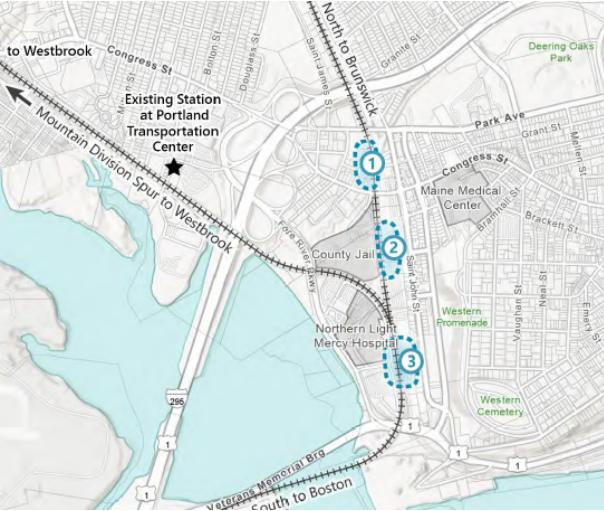
Train Relocation: GPL’s Executive Director Kate Lemos McHale recently attended a Portland City Council workshop about the proposed Amtrack Downeaster Station Relocation. Due to constraints at the current train station location, the Northern New England Passenger Rail Authority (NNEPRA) is considering two other sites for possible relocation of the station. One site is near the former site of Union Station, which was demolished in 1961, prompting the creation of Greater Portland Landmarks. GPL agrees with City of Portland leadership that this is the more advantageous site. NNEPRA, however, is pushing to relocate the train to an industrial area of the peninsula, near Cassidy Point. Either location would have immense impacts to the city and should be carefully analyzed. City Council will continue to consider the options with an expected vote by the end of the year, though it’s unclear if support by City Council would be required for this relocation project.
national:
Federal preservation protections at risk, Section 106: On Monday, November 9th the U.S. Senate voted 73 to 25 to proceed with the permitting bill that will gut protections for historic resources, cultural places, and the environment. Disguised as legislation that will fast-track wind and solar energy projects, this bill is a gift to the oil and gas industries that have spent hundreds of millions of dollars on lobbyists to eliminate reviews and permitting for their projects. This bill accomplishes that goal. It will end federal protections for historic places, many of which are not yet discovered or documented and will be completely destroyed by federal projects like pipelines and data centers.
Unfortunately, both Maine Senators, Susan Collins and Angus King, voted to advance the bill. GPL staff, along with other Maine preservation advocates, recently spoke with Senator King and his staff about this bill and provided facts, data, and case studies to demonstrate the harm that this bill will cause as well as suggested changes to the legislation. Ideally the Senate will reject this bill and collaborate with preservation and environmental experts, especially Tribal consultants, to create a better bill in the next Congress. We are hopeful that Senator King and others will push for meaningful changes to the bill, or the removal of the historic preservation title entirely, if they intend to vote in favor of its passage. This bill is being fast-tracked for approval by the end of this Congressional session and will likely not get the consideration and evaluation that it warrants unless we all speak out against it.
We need your help! Contact Maine’s delegation - Senators and Representatives - and ask them to reject this bill entirely as well as the revisions to Section 106 proposed by the Advisory Council on Historic Preservation which have similar devastating impacts. Tell them that America’s historic and cultural places matter.
The Senate could vote as early as Monday on the permitting bill (known as BAJAA (“Ba-Ha”) or the Bipartisan American Affordability and Jobs Act of 2026 (S. 5653). If is passes, it is expected to move quickly through the House, so reach out to both your Senators and Representatives TODAY.
Learn more at 106Strong.com
