Educational Summary

GPL VS. The City of Portland

Superior Court, Case #Ap-24-035

Understanding Zoning Code Policy

  • Portland’s historic preservation ordinance is part of the city’s land use code, which was recently updated through the ReCode process. It creates a framework for designating and regulating landmarks and historic districts.

  • A historic district is an area with streetscapes or a collection of buildings connected by history, architecture, or a combination, which have a recognizable historic character and create a special sense of place. Buildings in districts are identified as “contributing” if they are older than 50 years old and contribute to the character and history of the district.

  • Portland’s preservation ordinance adopts national historic preservation standards and as such, is a Certified Local Government which provides access to valuable grant funding for the city and individual property owners and organizations.

  • The review standards are administered by the City of Portland staff and in larger circumstances, like demolition or new construction, the Portland Historic Preservation Board.

  • While demolition of contributing buildings is not permitted, the standards are created to provide some flexibility for necessary change. Policy has adapted to protect significant historic character and monitor change while allowing development to occur. It is not intended to prohibit change.

142 Free Street and the Portland Museum of Art Development

  • 142 Free Street was constructed in 1830 as a theater – possibly the first in Maine after it became its own state – and soon redesigned as a church. In 1926 it was redesigned by prominent Maine architect John Calvin Stevens as the Portland Chamber of Commerce, and in the 1990s and early 2000s it was the home of the Children’s Museum of Maine.

  • 142 Free Street was designated as a contributing building within the Congress Street Historic District in 2009, based on its significant history and intact façade dating to its John Calvin Stevens design.

  • The Portland Museum of Art (PMA) purchased 142 Free in 2019 and showed its footprint as the development site in a design competition for a major expansion.

  • Rather than seeking to incorporate 142 Free Street in its expansion, PMA applied to the city to change its status from “contributing” to “non-contributing,” to facilitate its demolition. This involves a review process with standards set out in the preservation ordinance, first by the Historic Preservation Board, then the Planning Board, and finally the City Council.

  • The preservation ordinance states that a building must be found to not meet any of four criteria for significance, or is too altered to have integrity, to determine it is noncontributing. Both the HP Board and Planning Board found that these criteria were not met due to the building’s significant 1926 design and only minor exterior changes since then, and denied the application.

  • Despite the recommendations against it from the two lower boards, City Council voted 6-3 in favor of a change in the status, citing alterations since 1830.

  • Greater Portland Landmarks filed a Rule 80B complaint against the City of Portland on the grounds that City Council did not sufficiently apply the standards in the preservation ordinance (which follows national historic preservation standards) in particular the integrity standard, and did not provide an adequate explanation why they did not follow the recommendations of both lower boards who have the professional expertise to advise Council on these matters.

Maine Superior Court Case No. AP-24-035, Appeal Denied Ruling

  • Justice Deborah Cashman of the Cumberland County Superior Court ruled GPL does not have standing in this case and City Council has the legal freedom to make any determination they choose related to historic designations, regardless of the standards.

  • The city council approved the preservation ordinance that is intended to guide their decision-making. In ruling that 142 Free Street was “non-contributing” in 2024, the council was required to follow the same criteria and standards as were followed at the time of designation in 2009. Instead, they reversed the original finding despite the fact that the building has not changed since it was designated.

  • This deeply concerning outcome sets a precedent for development in Portland's historic districts. Any property owner of a designated building can follow this path and take their appeal to City Council for a change in status, citing this ruling, essentially opening the option to demolish a structure regardless of the land use code.

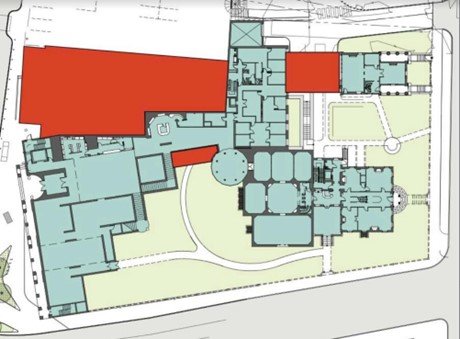
Photo Credit: David Gaines, 2023

142 FREE STREET

  • Important Notes On Location: Congress Street Historic District

  • Why Is GPL Engaged: The Portland Museum of Art applied to reclassify building as “non-contributing” to facilitate its full demolition.

  • Brief History: 142 Free Street was constructed in 1830 as a theater – possibly the first in Maine after it became its own state – and soon redesigned as a church. In 1926 it was redesigned by prominent Maine architect John Calvin Stevens as the Portland Chamber of Commerce, and in the 1990s and early 2000s it was the home of the Children’s Museum of Maine. The Portland Museum of Art (PMA) purchased 142 Free in 2019.


Latest News


Timeline

  • The Portland Museum of Art demolishes 142 Free Street

    The Portland Museum of Art has demolished 142 Free Street. With heavy machinery over a few days, PMA razed a building that stood for nearly 200 years, adapting and serving Portland in a variety of useful iterations. GPL staff visited the demolition site several times to document this event in our community, reflecting on the enormity of the loss and our efforts to prevent it. Dozens of Portlanders stopped to take photos; many shared memories and condemned the unnecessary destruction of a place that held meaning to them.

    Despite promises to salvage reusable materials from the building, it seems that very little was actually salvaged. The building was mechanically demolished, windows and all, instead of being dismantled for salvage. This represents a lack of commitment to sustainable methods. One of the best actions we can take for climate resilience is to reuse what we already have, especially buildings which capture embodied carbon, energy, and materials. New construction, no matter how energy-efficient the new building might be, produces a dangerous amount of waste and pollution. With few exceptions, existing buildings can be updated, upgraded, expanded, and successfully reused. These kinds of changes are approvable within historic districts and this building would have been no exception with more creative visioning by the museum. Historic buildings, after all, are some of the most visible and beloved forms of art.

    Looking ahead, there is still work to be done. GPL is committed to finding solutions to ensure this loss can't happen again. We will work with local leadership to review policies and procedures, identify any open doors that developers might use to circumvent the system, and propose revisions that more effectively protect historic resources. So much of Portland's identity is tied to its historic places. We have a system to protect those places and everyone should be held accountable to the guardrails within the system.

    PMA has paraded the images of their new addition in an attempt to gain support and justify their actions. But they have not yet begun their review process and there's no guarantee that their new building will come to fruition as currently conceived, especially since PMA, according to their public statement, has only raised about half of the funds required. In the meantime, the Congress Street Historic District will have an empty lot and maybe, eventually, a private pocket park, for an unknown length of time. Portland deserves better and it's our goal to ensure that in the future no building is demolished without a robust salvage plan, a funded project, and an approved new structure. 

    We would like to thank all those who have supported us throughout this long effort. You contributed to our legal fees, showed up to meetings in support of our position, and uplifted our messaging. You have proven that Portland cares about its historic places and the value of protecting them with rational and fair policy. Our advocacy work will continue to reflect that passion and purpose as we move forward. 

  • Greater Portland Landmarks Urges Museum To Keep It’s Pledge Not To Demolish Free Street Building Until Expansion Is Funded And Approved

    In a letter to the leadership of the Portland Museum of Art (PMA), Greater Portland Landmarks today urged the museum not to demolish the historic building at 142 Free Street before it has raised the necessary funds and received all city approvals for its proposed expansion on the site of the former Chamber of Commerce and Children’s Museum of Maine building. Despite earlier public assurances that it would hold off on tearing down the building, the PMA has now filed a demolition permit with the City of Portland.

    Over the objections of Landmarks and many members of the community, the PMA successfully lobbied the Portland City Council in 2024 to change the designation of building to “non-contributing” within the Congress Street Historic District, paving the way for its demolition. Landmarks appealed that decision and in April of this year a Superior Court justice upheld the council decision.

    In her letter, Landmarks’ Executive Director Kate Lemos McHale said she was “writing to appeal to you to please rethink your decision to move forward swiftly with the demolition of 142 Free Street before you have received approval and the necessary funding for its replacement. This action reverses promises that your team made publicly and in good faith when you asked the city to reclassify 142 Free Street so that the PMA may replace a part of the Congress Street Historic District's historic streetscape.”

    She went on to say that tearing down the existing building prior to completing the Historic Preservation Board’s review of its proposed replacement “runs counter to best practice and removes the chance that it could be rehabilitated should your current plans not come together as anticipated. Perhaps most significantly, it creates a vacant lot in the midst of a neighborhood in crisis.”

    Lemos McHale said that New York City, where she worked for the Landmarks Preservation Commission for many years before returning to Maine, does not approve demolition of buildings (even noncontributing) in historic districts before approving plans for an appropriate replacement, noting: “This is standard best practice from an urban design perspective, avoiding the very real risk that a project may not move forward for an unforeseen reason, or may be delayed for a considerable period, leaving a vacant lot.”

    Lemos McHale ended her letter with a plea to the PMA to “not take the step of demolishing the building before you are ready to replace it. Especially in this fragile location in the Arts District, which as we discussed in the Arts District Solutions Group is in crisis, the last thing we need is a vacant lot. We would be happy to work with you to support temporary uses to activate the building until you have your plans approved. There is nothing to be gained by demolishing it now, but so much for Portland and our community to lose.”

    “I believe many of those who supported the PMA expansion plans would agree that demolishing this building before the expansion is funded and approved is unnecessary and disingenuous,” said Lemos McHale. “I hope PMA members and supporters throughout the Greater Portland community will join us in urging the museum to keep its word.”

  • Greater Portland Landmarks Chooses Against a Second Appeal

    With broad support and encouragement, Greater Portland Landmarks strongly opposed the City Council order reclassifying 142 Free Street against the recommendations of the Historic Preservation and Planning Boards and filed an appeal of the order in Superior Court. While we disagree with the judge’s recent ruling against our appeal and are deeply disappointed by the outcome of this case, we must move forward in the best way possible for Portland and our community.

    We believe our resources are best directed toward ensuring this case remains an isolated incident rather than pursuing further legal action at this time. We do not want to see reclassification via this process become a pattern that threatens decades of work to create and implement a responsible, sustainable approach to historic preservation in Portland.  We will work to leverage this moment through outreach, education, programming, and collaboration to build and demonstrate broad public support for historic preservation for Portland’s future.

    As we continue to advocate for Portland's historic districts, we do not want this process to lead to the demolition of a prominent historic building leaving a vacant lot without approved plans for redevelopment. That would be a critical flaw in our system and the worst outcome for the community.

    We have strongly urged the PMA to consider an approach that incorporates the historic building within a bold new addition. And if not, to at least honor their commitment to the city and the community during the public review process and not demolish 142 Free Street until getting all approvals from the city for their expansion plans. We are glad to have found common ground on plans to preserve and activate the historic Clapp House on their campus, to document and salvage 142 Free Street's architectural elements should it be demolished, and to interpret its history within the museum.

     As we well know, the benefits of historic preservation are seen every day in thriving historic districts supporting commercial, cultural, civic, and residential uses in rehabilitated and new buildings. Greater Portland Landmarks is finalizing a new strategic plan committed to advancing these benefits through:

    • Creating a more community-driven preservation vision reflecting the city’s diverse history, priorities, and needs

    • Collaborating with the city on preservation goals in the comprehensive plan and in updates to the design manual

    • Supporting property owners in redeveloping historic district sites without unwarranted reclassification

    • Promoting adaptive reuse that aligns with sustainability and resilience goals to avoid the unnecessary environmental impacts of demolition and replacement of historic buildings.

    We are deeply grateful to everyone who supported our effort through your testimony, letters, encouragement, and donations, to our legal team at Murray Plumb & Murray, and to the National Trust who has provided important guidance.

    This process has given voice to so many people passionate about preserving historic character and concerned about protecting our effective preservation ordinance. We remain dedicated to working collaboratively toward ensuring Portland remains a vibrant city for all.

  • Justice Deborah Cashman Hands Down Appeal Denied Ruling

    Greater Portland Landmarks and our Board of Trustees, advisors, and supporters are committed to upholding Portland's vital historic preservation program. We are deeply disappointed by the judge's ruling and concerned for what it does to undermine historic preservation standards and the future of Portland's historic districts.

    Over the years historic preservation has played a major role in making Portland the vibrant city it is today. People from all the country and all over the world come here to live, work and visit because Portland stands out as a modern city that has retained its historic character.

    The court today has upheld a dangerous precedent set last year by the city council that threatens to undo decades of work to create a responsible, workable approach to historic preservation in Portland. Real implications include diminishing the effectiveness of our historic preservation program and putting our Certified Local Government (CLG) status—and the valuable funding it provides to the city and historic properties—at risk.  We are considering whether to appeal the decision and hope the Portland Museum of Art will continue constructive discussions with us.

    There is still time for the PMA to develop a plan that both preserves the primary character of 142 Free St. and allows the museum to expand. That would be a tremendous win/win for the entire community and we urge the PMA to work with us to find common ground.

    We are grateful for the tremendous outpouring of moral and financial support we have received in taking on this issue. We did not take this appeal lightly and while we are deeply disappointed in the judge’s ruling, we will continue to be an affirmative champion of historic preservation and the laws and programs that have served Portland so well for so long.

  • We were pleased to have the opportunity to press our case today, March 5, 2025, before Superior Court Justice Deborah Cashman to uphold the City of Portland’s Historic Preservation Ordinance and overturn the re-classification of 142 Free Street. We appreciated the questions that were asked by the court and how vigorously our attorney represented our position and the facts of the case.

    In the meantime, we have had constructive conversations with PMA leadership and are committed to work collaboratively with them to achieve their goals in a way that upholds the integrity of the City’s historic preservation programs.

    Responsible preservation has played a vital role in making Portland such a special place to live, work and visit, which is why we continue to fight so hard to protect these important standards. Our local ordinance closely follows long accepted national standards and is designed to be widely accessible and fairly applied.

    We remain optimistic about the ultimate outcome of the legal proceedings and look forward to a successful and positive resolution of this issue.

  • Read our press release here.

  • Our Statement

    City Meeting Archive

  • Our Statement

    City Meeting Archive

  • Our Statement

    City Meeting Archive

  • Our Statement

    City Meeting Archive

  • Read our full statement here.

  • Item description

in the Press


 December 7, 2022

Portland Museum of Art Campus Unification + Expansion

International Design Competition

Dear Design Competition Jury:

As the region’s nonprofit organization devoted to historic preservation, our mission is to ensure that Greater Portland preserves its sense of place for all and builds vibrant, sustainable neighborhoods and communities for the future. We offer these comprehensive comments on the proposals for expanding the Portland Museum of Art’s campus to provide guidance as you deliberate on which firm to select.

In addition to the architecturally and culturally significant Payson Building (built 1983) that is the signature facade of the institution, the PMA campus contains four historically and architecturally significant buildings: the McLellan House (built 1801), the Clapp House (built 1832), Sweat Memorial Galleries (built 1911), and 142 Free Street (former Children’s Museum, built 1830 and altered to its current configuration in 1926). Three of these historic buildings—all but the McLellan House—bear the marks of one of Maine’s most influential and important architects, John Calvin Stevens, who also was responsible for alterations to the museum’s satellite property on Prout’s Neck, the Winslow Homer Studio. The PMA is a major cultural institution dedicated to promoting the arts, a discipline that includes architectural history. As evidenced by its stewardship of Stevens’ legacy through ownership of a critical mass of his work, the PMA remains a critical node for citizen engagement with our architectural heritage and preservation of the same. Thus, its historic buildings directly contribute to the PMA’s mission of “Art for All.”

It is with this responsibility and collegial spirit in mind that we encourage the jury to select the firm that will best incorporate these historic properties into the campus design scheme. The design should refrain from elements that “wall off” properties abutting the Spring Street side of the campus and instead should encourage new architecture and landscaping to better incorporate these elements, even further highlighting and celebrating them as integral to the museum’s mission. Likewise, designs that overshadow or overpower them and the Payson building, the museum’s most-recent landmark of the twentieth century, do a disservice to the PMA’s bright future as a major city institution.

The four firms currently suggest retaining the McLellan, Clapp, and Sweat buildings, all of which are contributing structures both to Portland’s local Congress Street Historic District and the (federal) Spring Street National Register District. Yet, none of the proposed designs account for the fact that 142 Free Street is also a contributing building to both historic districts. As such, 142 Free Street enjoys preservation protections against demolition or reduction to a facade based on its significance as a structure of nearly 200 years and association with notable architects, including John Calvin Stevens. At the same time, its location helped dictate and inform the scope and design of the Payson building, as that facade was always in conversation with that of 142 Free Street.

While there is not a definitive statement in the RFQ regarding the preservation OR demolition of 142 Free Street, the language used, including reference to this area as the “site” for the “new building,” strongly suggests the PMA’s desire for demolition. We feel it is critical to understand the PMA’s intention for this historic building and that the PMA justify any desire or need for removal. As presented, none of the four finalists’ plans would meet requirements set forth in the city’s Historic Preservation Ordinance. Is demolition necessary to meet the PMA’s stated goals? Is it possible to explore how the existing building could be incorporated into a new campus design? We look forward to the opportunity for the preservation community to engage with the selected design team in advancing a publicly-supported vision for the future of the museum that honors historic architecture as “Art for All.”

We offer these comments to be constructive rather than detractive. We hope the jury will select a winner who has demonstrated experience working with historic places and spaces. The selected design firm will necessarily have to work with the city’s Historic Preservation Board’s design review process as the plans take shape. A comprehensive design team should exhibit both sensitivity and creativity in looking to unite the campus’s historic and contemporary buildings. This is key to successfully creating a community-supported landmark of the twenty-first century. Making a bold architectural statement is not inappropriate. In fact, we are excited about this project and expect that it will further establish the importance of PMA as the heart of the Arts District. As the museum looks to enhance its actions on accessibility and equity, we hope that you will also prioritize the stories that the historic structures on your campus represent. As the city’s historic preservation advocacy organization, we look forward to being actively involved in discussions about the future of this historic campus.

Sincerely,

Sarah Hansen, Executive Director
C. Ian Stevenson, Director of Advocacy

 28 September 2023

RE: CONGRESS STREET HISTORIC DISTRICT - RECLASSIFICATION OF 142 FREE STREET AS
NONCONTRIBUTING

Chair O’Brien and Members of the Historic Preservation Board,

In response to the Portland Museum of Art’s request to revise the classification of the former Chamber of Commerce building at 142 Free Street (more recently known as the Children’s Museum building), Greater Portland Landmarks has considered the historic preservation ordinance’s criteria for designation of a contributing structure within a local historic district in order to determine whether the Chamber of Commerce Building is more appropriately classified as non-contributing, as PMA suggests. Based on this analysis, Greater Portland Landmarks believes that the building clearly meets the criteria for designation as a contributing structure, both in terms of its architectural and historic significance within the Congress Street Historic District and its retention of the required level of integrity. Greater Portland Landmarks finds no basis for reclassification as a non-contributing structure.

As HP Board members are aware, the historic preservation ordinance clearly identifies criteria which must be met in order to be classified as a contributing structure within a district. During the district designation process, each structure or site is carefully evaluated in order to assign a classification of contributing, non-contributing or Landmark. This was done for the Congress Street Historic District and documentation on each building was included as part of the required designation materials.

Within the boundaries of any given district, inevitably there will be a number of structures which fail to meet the criteria for designation as a contributing structure either because they lack significance under any of the categories identified in the ordinance or because they do not exhibit sufficient integrity to be designated. For example, a building that is structurally unsound or has been altered on the exterior to such a degree it no longer retains its historic character will not meet the integrity standard and be classified noncontributing structure even if it is historically or architecturally significant.

The historic preservation ordinance requires that this same rigorous analysis be conducted when a request is made to change the classification of a structure or site within a district. The same criteria must guide the Board’s final determination and recommendation to the Council. In order to change the classification of a building from contributing to non-contributing, the Board must find that the original classification was erroneous (perhaps based on incomplete information) or that circumstances have changed such that the building no longer meets the required criteria (if a building becomes structurally unsound, for example). Since the ordinance was adopted in 1990, about a dozen buildings have been reclassified following the process outlined in the ordinance. Greater Portland Landmarks followed these requests and, in each case, supported the reclassification based on the ordinance criteria. In this case, however, Landmarks strongly believes that the evidence that led to the building’s original designation as a contributing building continues to exist and meets the minimum criteria set forth in the Ordinance.

EVALUATION BASED ON CRITERIA

We encourage the Board to consider the following in your discussion of the owner’s request to reclassify the former Chamber of Commerce Building to noncontributing.

17.5.9 Amendment or Rescission of a Designation Amendment or rescission of any designation shall ... follow the procedure set forth in Section 17.5 for designation...The standards for rescission or amendment applied by the Historic Preservation Board, Planning Board, and City Council shall be limited to those provided in Subsections 17.4.1(A) and (B) and Subsection 17.4.2.

17.4.1 Minimum Criteria for Designation 17.4.1.A. The ordinance limits consideration by the HPB to the following criteria in making a determination on ... an area, site, structure, or object for designation by ordinance as a landmark or district:

17.4.1.A.1. Its value as a significant example of the cultural, historic, architectural, archaeological, or related aspect of the heritage of the City of Portland, State of Maine, New England region, or the United States:

  • The Chamber of Commerce Building is an example of the commercial significance of Congress Street within Portland in the first half of the 20th century. It is also an example of the significance and prominence of Portland’s business community within the state and northern New England in the first half of the 20th century. At the turn of the century Congress Street from City Hall to Congress Square was noted for its fashionable shops and large department stores. Particularly between 1900 and 1930, the Congress Street business district replaced Exchange Street and the Old Port area as the business center of the city. At Congress Square this new commercial prominence is reflected in the construction of the Schwartz Building (1920), Eastland Hotel (1927), State Theater (1929), the third-story addition to the 1826 C.Q. Clapp Block/H.H. Hay Block (1922), and the alteration of the former Free Street Baptist Church for use by the Chamber of Commerce (1926).

17.4.1.A.4. Its exemplification of a significant architectural type, style, or design distinguished by innovation, rarity, uniqueness, or overall quality of design, detail, materials, or craftsmanship.

  • Redesigned in 1926 in the Colonial Revival Style, architects John Calvin Stevens and John Howard Stevens utilized the most popular style of the period. By the turn of the 20th century the Colonial Revival Style was one of the most predominant styles of architecture on the East Coast. It had quickly become the fashionable style in architecture following the Columbian Exposition of 1893 in Chicago. The style surged in prominence following World War I and again following World War II.

17.4.1.A.5. Its identification as the work of an architect, designer, engineer, or builder whose individual work is significant in the history or development of the City of Portland, the State of Maine, the New England region, or the United States.

  • John Calvin Stevens and his son John Howard Stevens are perhaps the most well-known and documented architects working in Portland at the turn of the 20th century. John Calvin Stevens significance to Portland and Maine’s architectural history is rivaled by his historic significance to Portland’s Art community and to the PMA itself:
    “He designed the museum’s L.D.M. Sweat Memorial Galleries. More importantly, he was a leader and president of the group that founded the museum. And it was he who secured the patronage that made the institution a reality and gave it staying power. But the Portland Society of Art not only founded the PMA, it created what is now the robust and thriving Maine College of Art, which many consider to be the most highly energized art institution in the art-oriented state of Maine.” (Portland Press Herald, July 5, 2015) In addition to the Chamber of Commerce Building other significant examples of the Colonial Revival style by the firm include Biddeford City Hall (1896), South Portland’s Roosevelt School (1927), Fryeburg Academy’s Curtis and Cutter Halls (1930) and Portland’s US Post Office (1934) on Forest Avenue.

17.4.1.A.6. Its representation of a significant cultural, historic, architectural, archaeological, or related theme expressed through distinctive areas, sites, structures, or objects that may or may not be contiguous.

  • The Chamber of Commerce Building is a contributing building within the Congress Street Historic District, an area locally designated in 2009 to document Portland’s business district. The building’s use by the Portland Chamber of Commerce for its offices from 1926-1993 expresses the commercial theme of the district. The building and its use are integral to an understanding of the Congress Street business district’s development during the first half of the 20th century.

17.4.1.B. In the case of a nominated historic district, the Historic Preservation Board shall also determine whether there is an interrelationship of resources within it which creates an identifiable entity, even if composed of a wide variety of resources. A district must convey a visual sense of the overall historic environment or be a grouping of historically or functionally related properties. A historic district can comprise both individually distinctive historic resources and historic resources that may lack individual distinction, but which contribute to the significance and visual character of the district as a whole.

The “eclecticism and layering of historical periods is the essence of the district’s character and what makes it unique among Portland’s historic districts.” - Congress Street Historic District, Local Designation Narrative.

  •  As stated above, the former Chamber of Commerce Building is a contributing building within the Congress Street Historic District. It expresses the commercial theme of the district and contributes to the district’s visual character. The Congress Street Historic District is a cohesive corridor of commercial and civic buildings that are significant for their role in the commercial, social, and architectural development of the city. Although flanked by a parking lot to the north, the Chamber of Commerce Building is visually related to its neighbors across Free Street, 133-135 Free Street (c1810-1820) and the Landmark-designated CQ Clapp Block/HH Hay Block at 588 Congress Street (built 1826 and altered 1922), and to the Payson Wing of the Portland Museum of Art next door. Like 133-135 Free Street and the HH Hay Block, the Chamber of Commerce Building is an early building altered to meet the changing needs of the evolving business district in the early 20th century. The former Chamber of Commerce Building is also visually related to its neighbor, the Payson Wing of the Portland Museum of Art and like the Payson Wing, its monumental facade helps to define the eastern boundary of Congress Square, a significant node within the boundary of the district.

17.4.2. Integrity of Landmarks and Historic Districts. Any area, structure, or object that meets the criteria in Section 17.4.1 must also have sufficient integrity of location, design, condition, materials, and workmanship to make it worthy of preservation or restoration.

  • The former Chamber of Commerce Building retains integrity of location, design, condition, materials, and workmanship. Although the building’s exterior has been altered since it was redesigned for use by the Chamber of Commerce, these alterations are reversible, have not significantly altered the character defining features of the building’s style, and do not detract from the overall appearance of the building.

    In fact, the building’s exterior condition is like many of its neighbors within the Congress Street Historic District. Most of the buildings within the district have undergone updates and alterations such as window or storefront replacements since their period of construction. However, the district’s contributing buildings typically retain their original (mainly brick) facades, storefront use, and character-defining architectural details.

    A comparison using the 1958 Portland Press Herald photograph presented in the applicant’s report and a more recent image of the buildings makes it clear that although alterations have occurred, the building retains its temple-form, major fenestration patterns, and the architectural details of its primary facade that are character defining elements of its Colonial Revival design and reflect its appearance during the building’s use by the Portland Chamber of Commerce.

CONCLUSION
For a building to be designated as a contributing structure, it needs to meet just one of the criteria laid out in Subsection 17.4.1.A of Portland’s Historic Preservation Ordinance. The former Chamber of Commerce Building meets 4 out of the 6 criteria. It also meets the criteria laid out in Subsection 17.4.1.B. and Subsection 17.4.2 of the ordinance. 

  • It is significant to the cultural, historic, architectural heritage of the city.

  • It exemplifies a significant architectural style.

  • It is the work of an architect whose individual work is significant in the history or development of the City of Portland and the State of Maine.

  • As the former home for nearly 60 years of the city’s Chamber of Commerce, it expresses and contributes to the theme of the Congress Street Historic District, a cohesive corridor of commercial and civic buildings that are significant for their role in the commercial, social, and architectural development of the city from 1780-1958.

  • Although minor alterations have been made to the exterior, it retains its temple-form, major fenestration patterns, and the architectural details of its primary facade that are character defining elements of its design and reflect its appearance during its use by the Portland Chamber of Commerce.

The former Chamber of Commerce building continues to warrant its designation as a contributing building within the historic district. We hope that through your careful deliberations, you will agree that the evidence supports its current designation.

Thank you for considering our views,

Carol De Tine
Vice President of the Board of Trustees
Greater Portland Landmarks

 25 October 2023

RE: CONGRESS STREET HISTORIC DISTRICT - RECLASSIFICATION OF 142 FREE STREET AS NONCONTRIBUTING

Chair O’Brien and Members of the Historic Preservation Board,

Greater Portland Landmarks does not oppose the expansion of the Portland Museum of Art’s campus and we are enthusiastic about the prospect of another landmark building being added to the museum's collection. We do not believe preservation of the former Chamber of Commerce Building and the introduction of a contemporary landmark are mutually exclusive.

As we addressed in our statement for the October workshop, Landmarks strongly believes that the former Chamber of Commerce Building clearly meets the criteria for designation as a contributing structure, both in terms of its architectural, historic, and thematic significance within the Congress Street Historic District and its retention of the required level of integrity to its 1926 appearance. The PMA’s reclassification request includes a consultant report that focuses largely on interior alterations, which are not under the purview of the Historic Preservation Board, and the early history of the building, rather than the integrity of the building’s exterior appearance since its 1926 alteration. The building’s exterior is largely unchanged from its appearance in 1926 or from its appearance when it was evaluated for inclusion in the Congress Street Historic District. Greater Portland Landmarks finds no basis in the consultant’s report for reclassification of the building as a non-contributing structure.

While not designated as an individual landmark, the former Chamber of Commerce building, like all contributing buildings, in combination with its neighbors forms the cohesive fabric essential to the establishment of a historic district. In addition, the former Chamber of Commerce Building meets 4 out of the 6 criteria laid out in Subsection 17.4.1.A of Portland’s Historic Preservation Ordinance. It also meets the criteria laid out in Subsection 17.4.1.B. and Subsection 17.4.2 of the ordinance.

  • It is significant to the cultural, historic, architectural heritage of the city.

  • It exemplifies a significant architectural style.

  • It is the work of an architect whose individual work is significant in the history or development of the City of Portland and the State of Maine.

  • As the former home for nearly 60 years of the city’s Chamber of Commerce, it expresses and contributes to the theme of the Congress Street Historic District, a cohesive corridor of commercial and civic buildings that are significant for their role in the commercial, social, and architectural development of the city from 1780-1958.

  • Although minor alterations have been made to the exterior, it retains its temple-form, major fenestration patterns, and the architectural details of its primary facade that are character defining elements of its design and reflect its appearance during its use by the Portland Chamber of Commerce.

The Portland Museum of Art’s collection is significant to the art history and culture of Maine. The largest pieces in the PMA’s collection are its five historic buildings. This expansion project is an opportunity to further unify all the varied historic buildings on the museum’s campus. Greater Portland Landmarks believes that there are options to meet the Museum’s worthy goals and to preserve the former Chamber of Commerce Building on Free Street.

Portland has examples of the beneficial results that can occur when demolition plans are reconsidered. One such example occurred in the 1990s when plans to demolish the interior of Portland’s Merrill Auditorium were touted as the only means to achieve state-of-the-art acoustics. The demolition plans were resisted by a vocal group of citizens who advocated for a second opinion. Experts capable of improving the concert hall’s acoustics while preserving the historic interior were then hired. The result is a beautiful venue that serves as a cultural hub supporting a diverse variety of programming.

Landmarks does not believe the best way forward is the demolition of one of the PMA’s largest assets. Instead, we encourage the PMA to work creatively with their architects and with the Historic Preservation Board to seek a Certificate of Appropriateness that incorporates the former Chamber of Commerce building into its campus expansion project.

The vote to reconsider the designation of the former Chamber of Commerce Building is significant not only for this application, but also significant to maintaining the integrity of the ordinance itself and to the preservation of other contributing structures throughout the City’s historic districts. We hope that you will apply the criteria of the ordinance in this case as you do in all development projects, large and small, that you consider. In your careful deliberation we urge you to agree that the evidence supports the former Chamber of Commerce building’s continued designation as a contributing building within the historic district.

Thank you for considering our views,

Carol De Tine
Vice President of the Board of Trustees
Greater Portland Landmarks

 24 November 2023

RE: CONGRESS STREET H.D. - RECLASSIFICATION OF 142 FREE STREET AS NONCONTRIBUTING

Chair Mazer and Members of the Planning Board,

Greater Portland Landmarks urges you to concur with the Historic Preservation Board’s unanimous finding to maintain the designation of the former Chamber of Commerce Building, more recently known as the Children’s Museum, as a contributing building within the Congress Street Historic District.

  • It more than meets the criteria for contributing status.

  • There is strong public support for preserving the building.

  • It meets the Portland Plan 2030 goals.

  • The Portland Museum of Art’s expansion and preservation goals are not mutually exclusive.

  • It is important to maintain the fair application and integrity of the historic preservation ordinance.

 Clearly Meets Criteria For Contributing Status
Although minor reversible alterations have been made to the exterior, it retains its integrity through its temple- form, major fenestration patterns, and the architectural details of its primary facade that are character defining elements of its design and reflect its appearance during its use by the Portland Chamber of Commerce.

For a building to be designated as a contributing structure, it needs to meet just one of the criteria laid out in Subsection 17.4.1.A of Portland’s Historic Preservation Ordinance. The former Chamber of Commerce Building meets 4 out of the 6 criteria. It also meets the criteria laid out in Subsection 17.4.1.B. and Subsection 17.4.2 of the ordinance. 

· 17.4.1.A.1 It is significant to the cultural, historic, and architectural heritage of the city as an example of Congress Street’s commercial significance in the first half of the 20th century.

 · 17.4.1.A.4 It exemplifies a significant architectural style from its 1926 redesign by architects John Calvin Stevens and John Howard Stevens in the Colonial Revival Style, the most popular style of the period.

 · 17.4.1.A.5 It is the work of architect John Calvin Stevens and his son John Howard Stevens, whose individual work is significant in the history and development of the City. John Calvin Steven’s significance to Portland and Maine’s architectural history is rivaled by his historic significance to Portland’s Art community and to the PMA itself:

 “He designed the museum’s L.D.M. Sweat Memorial Galleries. More importantly, he was a leader and president of the group that founded the museum. And it was he who secured the patronage that made the institution a reality and gave it staying power. But the Portland Society of Art not only founded the PMA, it created what is now the robust and thriving Maine College of Art, which many consider to be the most highly energized art institution in the art-oriented state of Maine.” Portland Press Herald, July 5, 2015

 · 17.4.1.A.6. As the former home for nearly 60 years of the city’s Chamber of Commerce, it expresses and contributes to the theme of the Congress Street Historic District, a cohesive corridor of commercial and civic buildings that are significant for their role in the commercial, social, and architectural development of the city from 1780-1958.

A recent image of the building (left) and a 1958 image from the Portland Press Herald (right).

Public Comment on the Importance of Retaining the Chamber of Commerce Building
During the Historic Preservation Board deliberations, the retention of the former Chamber of Commerce building received significant support from the public, with 59 of the 68 public comments submitted to the city opposed to its demolition. The reclassification and demolition of a contributing historic building within one of Portland’s historic districts would set a dangerous precedent. One of the public comments regarding the proposed demolition:

I write to urge you to save 142 Free St and not establish a dangerous precedent that could endanger many more of our treasured historic buildings. The historic character of our downtowns enriches our communities and provides a unique sense of place. This is a very important decision that cities and towns around the State of Maine will be closely watching.” Bryan Kaenrath, Waterville City Manager

In place for more than thirty years, the ordinance has set out expectations for all applicants to follow. Its fair and equitable application has helped to enhance the city’s economic and cultural success. The recently released “Trends in Portland’s Historic Districts” report states “Portland’s historic character is a…fundamental part of the city’s identity, as expressed throughout the City’s vision statement and comprehensive City goals.”

The Camiros report offers the City recommendations based on comparing Portland’s Plan 2030 goals to current land use regulations in order to better align the Land Use Code with the Comp Plan. It recommends that the Recode project “…involve considerations for ensuring that new development respects the city’s rich history and that, in the face of new development, essential elements of the city’s history are preserved.”

Preservation of 142 Free Street Meets Portland’s Plan 2030 Goals
Portland has been built and rebuilt to endure; we will balance our historic fabric, sound infrastructure, and the best of new technology and design for the future.” From the Vision Statement, Portland’s Plan 2030.

The City and the community have invested significant time and funds into improvements to Congress Square, a significant node within the Arts District and the Congress Street Historic District. The PMA’s plan, which would necessitate the removal of the former Chamber of Commerce Building, would also remove the existing main entrance to the museum from Congress Square and locate a new entrance on High Street. In our opinion this is counter to the Comprehensive Plan’s goals to enhance the downtown, the Arts District, and undermines the ongoing planning and implementation to revitalize Congress Square.

Museum Expansion and Preservation Goals Are Not Mutually Exclusive
Although the applicant has a design proposal that necessitates the former Chamber of Commerce Building’s removal, the PMA purchased the building knowing its historic designation and solicited design proposals without acknowledging the building’s historic designation to design teams. In fact, the map included with the museum’s RFP had no building shown in the location of the Chamber of Commerce Building. Greater Portland Landmarks supports the PMA’s desire to expand, but strongly believes there remains opportunity in the design process to reconsider the demolition of a contributing historic resource and the potential impact of the new addition on Congress Square. The architect’s job is to take complex program elements and creatively synthesize those with the existing site. We strongly encourage the PMA to reconsider its proposal and we urge you to agree.

“Developable Space” Site plan of the PMA’s existing campus included in the design RFP. 142 Free Street was not depicted.

Reconsideration of the current design path is not unprecedented. In New York State, the Buffalo AKG museum’s initial expansion plans by OMA were fundamentally changed based on public reaction to the initial plans. The new building addition, which opened recently, honors the museum’s 1905 original building, its 1962 modern addition, and improves the dialogue between the museum and the Frederick Law Olmsted designed park in which the museum sits. The transformed AKG Museum meets all of the museum’s goals while preserving and respecting the museum’s architectural history.

 Portland has examples of the beneficial results that can occur when demolition plans are reconsidered. One such example occurred in the 1990s when plans to demolish the interior of Portland’s Merrill Auditorium were touted as the only means to achieve state-of-the-art acoustics. The demolition plans were resisted by a vocal group of citizens who advocated for a second opinion. Experts capable of improving the concert hall’s acoustics while preserving the historic interior were then hired. The result is a beautiful historic venue that with its state of the art acoustics, has continued to serve as a cultural hub supporting a diverse variety of programming.

 Fair Application of the Ordinance
17.5.9 Amendment or Rescission of a Designation
Amendment or rescission of any designation shall ... follow the procedure set forth in Section 17.5 for designation...The standards for rescission or amendment applied by the Historic Preservation Board, Planning Board, and City Council shall be limited to those provided in Subsections 17.4.1(A) and (B) and Subsection 17.4.2

The Historic Preservation Ordinance clearly limits the Planning Board’s consideration to those Standards found in Section 17.4.1 (A) and (B). The Historic Preservation Board, although sympathetic to the desire of the PMA to expand, unanimously determined that the former Chamber of Commerce Building meets the standards laid out in Subsections 17.4.1(A) and (B) and Subsection 17.4.2. The former Chamber of Commerce building continues to warrant its designation as a contributing building within the historic district. Moreover, its retention helps meet key goals of Portland’s Plan 2030. We hope that through your careful deliberations, you will agree that the evidence supports its current designation.

Conclusion
The PMA must reconsider its options for expansion. The city block occupied by the PMA includes several surface parking lots, including one owned by the PMA. The reclassification and demolition of a historic building which contributes to the character of the Congress Street corridor and Congress Square, a significant urban gathering space, cannot be allowed when other options exist to meet the museum’s space needs while further enhancing the city’s streetscapes. We hope that you will reject the PMA’s proposal and encourage them to return with a project that retains the integrity of the Congress Street Historic District and creates a world class museum.

Thank you for considering our views,

Carol De Tine
Vice President of the Board of Trustees Greater Portland Landmarks

8 February 2024

RE: CONGRESS STREET HISTORIC DISTRICT - RECLASSIFICATION OF 142 FREE STREET AS NONCONTRIBUTING

Chair Mazer and Members of the Planning Board,

We offer the following comments in addition to the letter submitted by our attorneys at Murray, Plumb & Murray.

Greater Portland Landmarks supports the expansion of the Portland Museum of Art but does not believe that the expansion necessitates the demolition of 142 Free Street, an action that would occur if the building was reclassified as non-contributing. Landmarks believes that the former Chamber of Commerce Building at 142 Free Street (more recently known as the Children’s Museum building), clearly meets the historic preservation ordinance’s criteria for designation as a contributing structure in a historic district. Landmarks strongly believes that the evidence that led to the building’s original designation as a contributing building in the historic district continues to exist and meets the minimum criteria set forth in the Ordinance.

EVALUATION BASED ON CRITERIA

During any district designation process, each structure or site is carefully evaluated and assigned a classification of Landmark, contributing, or non-contributing. This was done for the Congress Street Historic District and documentation on each building was included as part of the required designation materials that were reviewed and approved by the Historic Preservation Board, the Planning Board, and the City Council.

Section 17.5.9 of the Ordinance, “Amendment or Recission of a Designation” identifies the standards for recission or amendment. The standards for a decision by the Planning Board are limited to those provided in Subsections 17.4.1(A) and (B), and Subsection 17.4.2. Subsection 17.4.1(A), sets out the minimum criteria for determining a building’s significance, Subsection 17.4.1(B) sets out the criteria for determining if a historic district possesses a significant concentration, linkage, or continuity of structures, and Subsection 17.4.2, sets out the criteria for assessing the building’s integrity, meaning its ability to convey its historical associations or attributes. The status of 142 Free Street was carefully considered. As we demonstrate below, the building met all of the criteria when it was originally classified as contributing. No significant changes to the building since that date or new information regarding its structural instability have been presented by the applicant that justify a change in the original determination. We encourage the Planning Board to consider the following in your discussion of the owner’s request to reclassify the former Chamber of Commerce Building to noncontributing.

142 Free Street Still Meets the Minimum Criteria for Determining Significance

17.4.1.A. The ordinance limits consideration by the Board to the following criteria in making a determination on … an area, site, structure, or object for designation by ordinance as a landmark or district:
17.4.1.A.1. Its value as a significant example of the cultural, historic, architectural, archaeological, or related aspect of the heritage of the City of Portland, State of Maine, New England region, or the United States:

• The Chamber of Commerce Building is an example of the commercial significance of Congress Street within Portland in the first half of the 20th century. It is also an example of the significance and prominence of Portland’s business community within the state and northern New England in the first half of the 20th century. At the turn of the 20th century Congress Street from City Hall to Congress Square was noted for its fashionable shops and large department stores. Particularly between 1900 and 1930, the Congress Street business district replaced Exchange Street and the Old Port area as the business center of the city. At Congress Square this new commercial prominence is reflected in the construction of the Schwartz Building (1920), Eastland Hotel (1927), State Theater (1929), the third-story addition to the 1826 C.Q. Clapp Block/H.H. Hay Block (1922), and the alteration of the former Free Street Baptist Church for use by the Chamber of Commerce (1926).

17.4.1.A.4. Its exemplification of a significant architectural type, style, or design distinguished by innovation, rarity, uniqueness, or overall quality of design, detail, materials, or craftsmanship.

  • Redesigned in 1926 in the Colonial Revival Style, architects John Calvin Stevens and John Howard Stevens utilized the most popular style of the period. By the turn of the 20th century the Colonial Revival Style was one of the most predominant styles of architecture on the East Coast. It had quickly become the fashionable style in architecture following the Columbian Exposition of 1893 in Chicago. The style surged in prominence following World War I and again following World War II.

17.4.1.A.5. Its identification as the work of an architect, designer, engineer, or builder whose individual work is significant in the history or development of the City of Portland, the State of Maine, the New England region, or the United States.

  • John Calvin Stevens and his son John Howard Stevens are perhaps the most well-known and documented architects working in Portland at the turn of the 20th century. John Calvin Stevens’ significance to Portland and Maine’s architectural history is rivaled by his historic significance to Portland’s Art community and to the PMA itself:

    “He designed the museum’s L.D.M. Sweat Memorial Galleries. More importantly, he was a leader and president of the group that founded the museum. And it was he who secured the patronage that made the institution a reality and gave it staying power. But the Portland Society of Art not only founded the PMA, it created what is now the robust and thriving Maine College of Art, which many consider to be the most highly energized art institution in the art-oriented state of Maine.” Portland Press Herald, July 5, 2015.

    In addition to the Chamber of Commerce Building other significant examples of the Colonial Revival style by the firm include Biddeford City Hall (1896), South Portland’s Roosevelt School (1927), Fryeburg Academy’s Curtis and Cutter Halls (1930) and Portland’s US Post Office (1934) on Forest Avenue.

17.4.1.A.6. Its representation of a significant cultural, historic, architectural, archaeological, or related theme expressed through distinctive areas, sites, structures, or objects that may or may not be contiguous.

  • The Chamber of Commerce Building is a contributing building within the Congress Street Historic District, an area locally designated in 2009 to document Portland’s business district. The building’s use by the Portland Chamber of Commerce for its offices from 1926-1993 expresses the commercial theme of the district. The building and its use are integral to an understanding of the Congress Street business district’s development during the first half of the 20th century.

142 Free Street Still Possesses a Significant Linkage with Other Structures within the Historic District.

17.4.1.B. In the case of a nominated historic district, the Board shall also determine whether there is an interrelationship of resources within it which creates an identifiable entity, even if composed of a wide variety of resources. A district must convey a visual sense of the overall historic environment or be a grouping of historically or functionally related properties. A historic district can comprise both individually distinctive historic resources and historic resources that may lack individual distinction, but which contribute to the significance and visual character of the district as a whole.

The “eclecticism and layering of historical periods is the essence of the district’s character and what makes it unique among Portland’s historic districts.” Congress Street Historic District, Local Designation Narrative.

  • While this section applies to historic districts, as stated above, the former Chamber of Commerce Building is a contributing building within the Congress Street Historic District. The Congress Street Historic District’s commercial and civic buildings form a cohesive corridor that are physically related. They are also thematically related by their significant role in the commercial, social, and architectural development of the city. The former Chamber of Commerce Building expresses the commercial theme of the district and contributes to the district’s visual character through its relationship to other historic buildings at Congress Square.

    • Although adjacent to a large parking lot, the Chamber of Commerce Building is visually related to its neighbors across Free Street, 133-135 Free Street (c1810-1820) and the Landmark-designated Charles Q Clapp Block/HH Hay Block at 588 Congress Street (built 1826 and altered 1922 by John Calvin Stevens). The Chamber of Commerce Building is also thematically related to 133-135 Free Street and the HH Hay Block. All three are early buildings altered to meet the changing needs of the evolving business district in the early 20th century.

    • The former Chamber of Commerce Building is also visually related to its neighbor, the Payson Wing of the Portland Museum of Art. The Payson Building, although built less than 50 years ago, is considered part of the Landmark-designated Museum campus. Together the two buildings’ monumental facades help to define the eastern boundary of Congress Square, a significant node within the historic district.

142 Free Street Still Meets the Criteria of Building Integrity

The National Parks Service standards upon which Portland’s ordinance is based, do not require the materials, features, and spaces of buildings to be original to be considered “historic” and “character-defining.” A structure can be significant not only for the way it was originally constructed or crafted, but also for the way it was adapted at a later period to illustrate changing tastes, attitudes, and uses over a period of time. The Congress Street Historic District is largely significant as a commercial corridor, and the 1926 alterations of the 142 Free Street building reflect the evolving commercial character of Congress Square in the early 20th century. The period of its history from 1926 onward is the time-period from which its integrity is considered.

17.4.2. Integrity of Landmarks and Historic Districts. Any area, structure, or object that meets the criteria in Section 17.4.1 must also have sufficient integrity of location, design, condition, materials, and workmanship to make it worthy of preservation or restoration.

  • The former Chamber of Commerce Building possesses integrity of location as it remains in its historic Free Street location.

  • The building retains its integrity of design, although altered by replacement windows and doors, and additions necessary for code requirements and its use as a museum, the major Colonial Revival design features of the Chamber of Commerce building as designed by the Stevens firm (in particular at the Free Street elevation) have not been irretrievably destroyed. The building retains its temple-form, major fenestration patterns, and the architectural details of its primary facade that are character defining elements of its design and reflect its appearance during its use by the Portland Chamber of Commerce. In the technical language of the historic preservation ordinance, the building retains its design integrity, its ability to convey the historical association and the physical attributes that were present during the nearly 60 years the building served as the Chamber’s headquarters.

  • The building retains its integrity of condition, as it is structurally sound according to the applicant’s statements before the Historic Preservation Board, although like any building that has not been updated for a period of time, it would need to have some alterations for code requirements for any potential new use.

  • The building retains its integrity of materials, although some historic materials have been lost through the replacement of windows and doors, the structure still retains significant amounts of historic materials including the masonry walls and extensive decorative trim and details of the temple front. In fact, the building’s exterior condition is like many of its neighbors within the Congress Street Historic District. Most of the buildings within the district have undergone updates and alterations such as window or storefront replacements since their period of construction. However, the district’s contributing buildings typically retain their original (mainly brick) facades, storefront use, and character-defining architectural details.

  • The building retains its integrity of workmanship, although some historic workmanship was lost through the replacement of windows and doors, the structure still retains significant evidence of historic workmanship in the masonry walls and in the extensive decorative trim and details of the front façade. The loss of original window, door, and storefront materials is typical in the historic district.

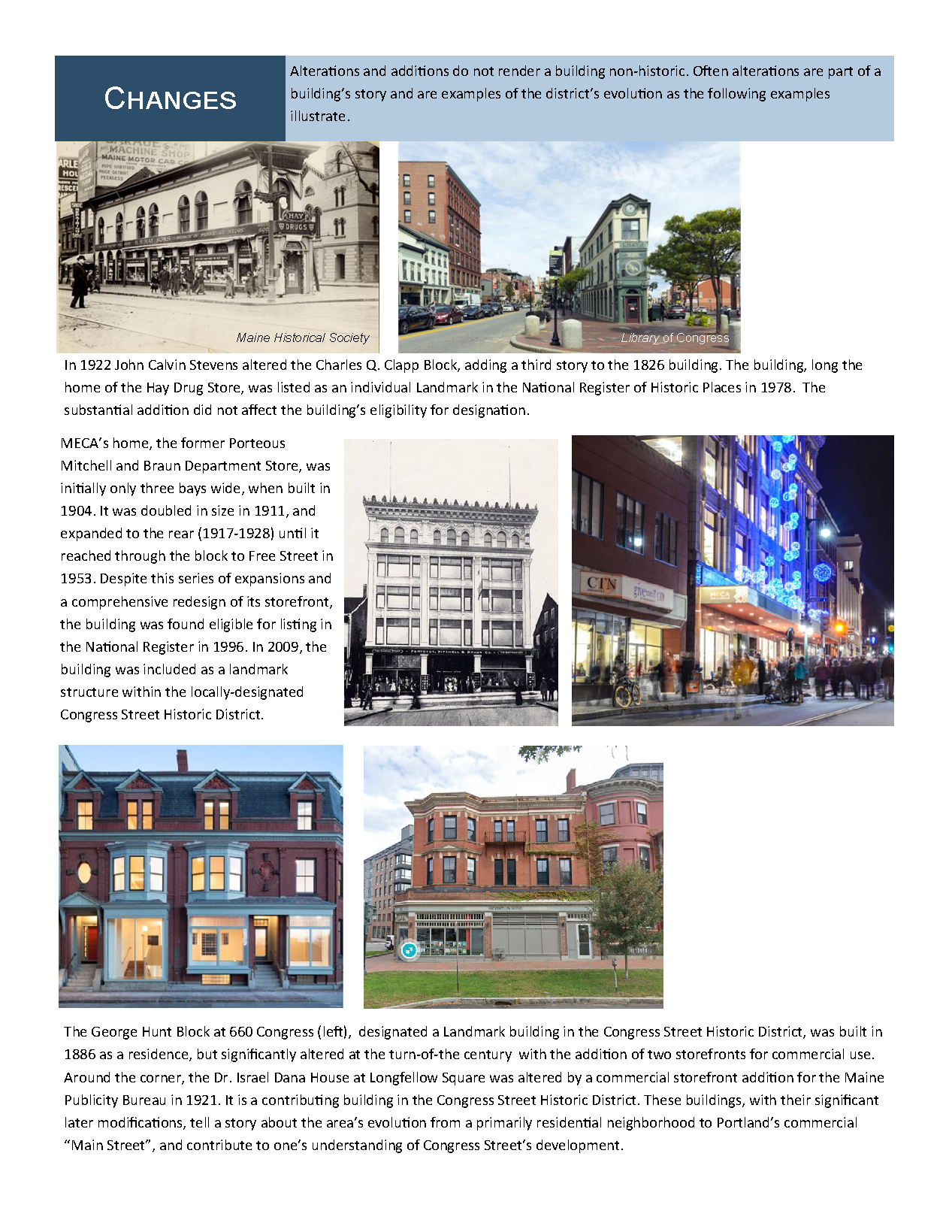
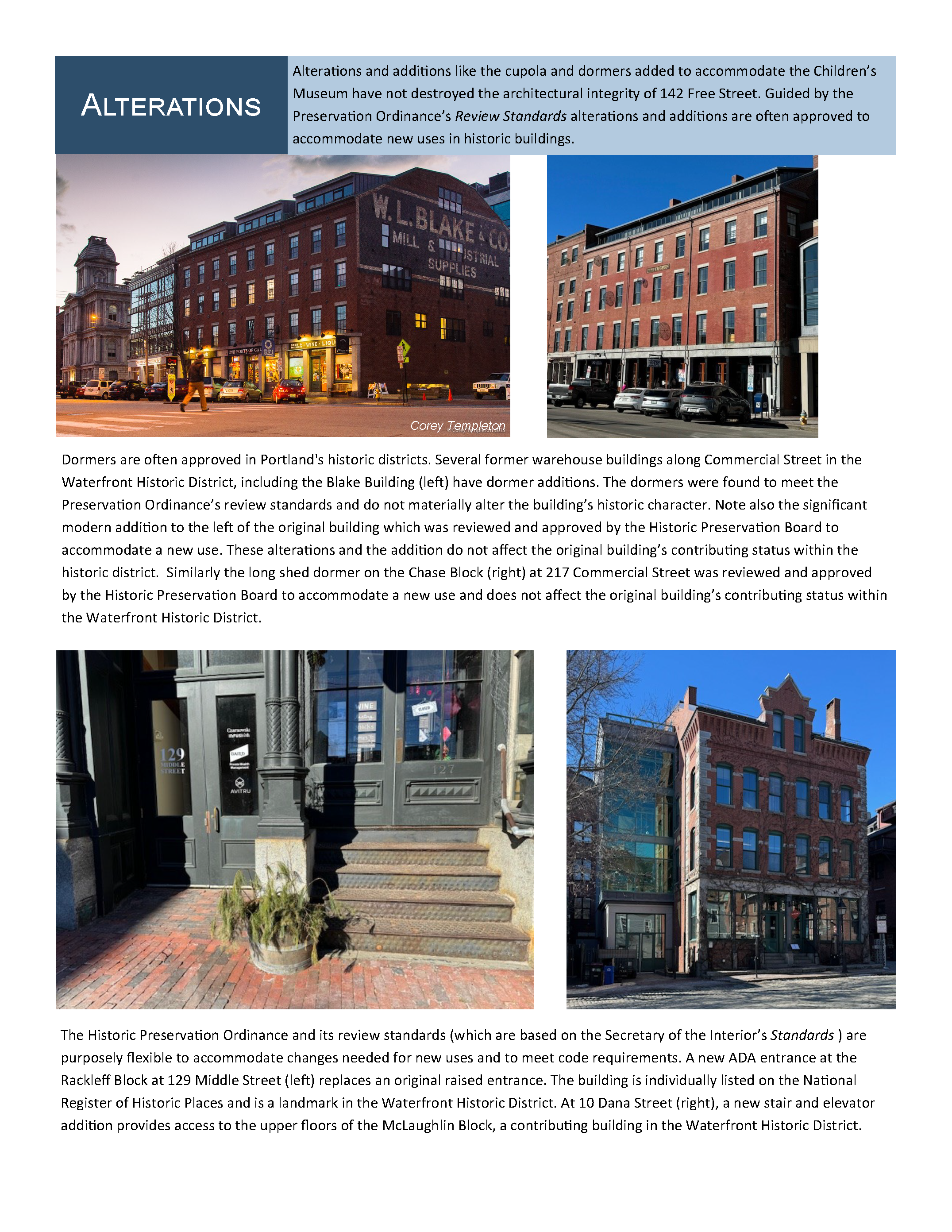
The Chamber of Commerce Building was first identified as historically significant when it was included within the boundary of the Spring Street Historic District when that district was added to the National Register of Historic Places in 1970. After that listing, the building’s exterior was minimally altered for its use by the Children’s Museum in the early 1990s. Alterations to accommodate new uses are not necessarily evidence of lack of integrity, in fact the review standards are intentionally flexible to accommodate changes that facilitate a building’s reuse (see attached images). When the building was documented for the Congress Street Historic District’s designation report, the code required additions and rooftop alterations by the Children’s Museum were noted and the alterations did not affect its contributing status. The alterations are reversible and therefore the altered features are not “irretrievably lost”. The alterations have not significantly altered the character defining features of the building’s Colonial Revival style, form, and primary facade, and do not detract from the overall appearance of the building.

A comparison using the 1958 Portland Press Herald photograph presented in the applicant’s report and a more recent image of the buildings makes it clear that although alterations have occurred, the building retains its temple-form, major fenestration patterns, and the architectural details of its primary facade that are character defining elements of its Colonial Revival design and reflect its appearance during the building’s nearly 60 year use by the Portland Chamber of Commerce.

CONCLUSION
For a building to be designated as a contributing structure, it needs to meet just one of the criteria laid out in Subsection 17.4.1.A of Portland’s Historic Preservation Ordinance. The former Chamber of Commerce Building meets 4 out of the 6 criteria. It also meets the criteria laid out in Subsection 17.4.1.B. and Subsection 17.4.2 of the ordinance.

  • It is significant to the cultural, historic, architectural heritage of the city.

  • It exemplifies a significant architectural style.

  • It is the work of an architect whose individual work is significant in the history or development of the City of Portland and the State of Maine.

  • As the former home for nearly 60 years of the city’s Chamber of Commerce, it expresses and contributes to the theme of the Congress Street Historic District, a cohesive corridor of commercial and civic buildings that are significant for their role in the commercial, social, and architectural development of the city from 1780-1958.

  • Although minor alterations have been made to the exterior, it retains its temple-form, major fenestration patterns, and the architectural details of its primary facade that are character defining elements of its design and reflect its appearance during its use by the Portland Chamber of Commerce. In the technical language of the historic preservation ordinance, the building retains its integrity, its ability to convey its historical association and the physical attributes that were present during the nearly 60 years the building served as the headquarters of Portland’s Chamber of Commerce.

The former Chamber of Commerce building continues to warrant its designation as a contributing building within the historic district. There is no basis for rescinding its designation. We hope that through your careful deliberations, you will agree that the evidence supports its current designation.

We urge the applicant to work with their consultants to incorporate142 Free Street into their proposal, and to return to the Historic Preservation Board to obtain a Certificate of Appropriateness so that they may move forward with their expansion plans to create a more welcoming and inclusive museum.

Thank you for considering our views,

Carol De Tine
Vice President of the Board of Trustees
Greater Portland Landmarks

Attachment:
Images of altered buildings which retain their historic character and significance in Portland’s historic districts

City of Portland City Council Contact List

Key Talking Points for City Council Outreach

(If you have questions not answered here, check our FAQs page!)

  • Greater Portland Landmarks does not oppose the expansion of the PMA campus, which is home to several historic buildings. However, we find no basis for reclassification of the 142 Free St. building as a non-contributing structure in the historic district and firmly believe the PMA can achieve its expansion plans without demolishing it. Portland’s Historic Preservation Board and Planning Board agreed with our position.

  • Portland’s Historic Preservation Ordinance expressly forbids the City Council from considering any provisions in the City’s comprehensive plan, “Portland’s Plan 2030” when it contemplates whether to decide that the building be reclassified. The City Council must only apply the criteria in the Historic Preservation Ordinance when considering the applicant’s request to change the classification of the building.

  • During the district designation process, each structure or site is carefully evaluated in order to assign a classification of contributing, non-contributing or Landmark. The building at 142 Free Street is identified as a contributing building in the Spring Street National Register Historic District (1970) and in the Congress Street Local Historic District (2009).

  • For a building to be designated as a contributing structure, it needs to meet just one of the criteria laid out in Subsection 17.4.1.A of Portland’s Historic Preservation Ordinance. The former Chamber of Commerce Building meets 4 out of the 6 criteria. It also meets the criteria laid out in Subsection 17.4.1.B. and Subsection 17.4.2 of the ordinance

    • It is significant to the cultural, historic, architectural heritage of the city.

    • It exemplifies a significant architectural style.

    • It is the work of an architect whose individual work is significant in the history or development of the City of Portland and the State of Maine.

    • As the former home for nearly 60 years of the city’s Chamber of Commerce, it expresses and contributes to the theme of the Congress Street Historic District, a cohesive corridor of commercial and civic buildings that are significant for their role in the commercial, social, and architectural development of the city from 1780-1958.

    • Although minor alterations have been made to the exterior, it retains its temple-form, major fenestration patterns, and the architectural details of its primary facade that are character defining elements of its design and reflect its appearance during its use by the Portland Chamber of Commerce. In the technical language of the historic preservation ordinance, the building retains its integrity, its ability to convey its historical association and the physical attributes that were present during the nearly 60 years the building  served as the headquarters of Portland’s Chamber of Commerce.

  • If you are looking for all the details on this continuing battle, please visit our full page on 142 Free Street.

Opinion: Who is historic preservation for? It’s for all of us.

The ordinance protecting 142 Free Street – the building the Portland Museum of Art is trying to demolish – should not be challenged.

AUTHORS: Bruce Roullard, President, and Carol DeTine, Vice-President, Board of Trustees of Greater Portland Landmarks.

A March 22 Press Herald op-ed asked: “Who is historic preservation for?”

At Greater Portland Landmarks we have been working to answer that for 60 years.

Historic preservation is for all of us, whether our families have been here for generations or are recently arrived immigrants from a foreign land. Most important, historic preservation is for future generations, so that they will have a better appreciation of where we’ve been as a community and where we need to go.

As the National Park Service states on its website: “Historic preservation is an important way for us to transmit our understanding of the past to future generations.”

And make no mistake, our understanding of the past is continually evolving, leading in many cases to a more open, honest and inclusive accounting of our history and the people and places that shaped it. We embrace that and are doing our part to ensure the stories of underrepresented communities are told and preserved.

We also have played a leading role in establishing clear, reasonable and fact-based criteria for protecting Portland’s historic buildings and neighborhoods, far too many of which had already been lost when Portland finally adopted a comprehensive historic preservation ordinance in 1990.

That ordinance has helped to create more than a dozen historic districts throughout the city, which have in turn attracted millions of dollars in public and private investment and have helped make Portland one of the most attractive destinations in the country for new residents and visitors.

Ordinance criteria ensure that all properties within a district are properly evaluated as to their historic value and that all property owners in a district play by the same rules, regardless of their financial means or prominence in the community. Those criteria protect all of us from ill-advised plans and undue political influence.

But now the very integrity of that ordinance is being challenged by the Portland Museum of Art, which is asking the Portland City Council to arbitrarily change the classification of the former Children’s Museum building at 142 Free St. so that it can tear it down to make way for a major expansion.

The writer of the March 22 op-ed cites the gender and color of the expansion’s lead architect; the fact that the designers have engaged a Wabanaki consultant; the musuem’s plans to use Maine timber; and the expectation of thousands of new visitors as reasons to ignore the ordinance and allow the museum to tear down a “contributing structure” within the Congress Street Historic District.

While all of those points are laudable, they could just as easily apply to an expansion plan that respects and includes the historic status of a building that the museum bought in 2019 – knowing full well that it could not be demolished.

Does that mean preservation advocates can’t do more to ensure the history and stories of underrepresented communities are preserved? Of course not. In fact, all across the country in cities that have historic preservation ordinances very similar to Portland’s, more and more sites connected with underrepresented populations are being nominated and given historic designations.

At Greater Portland Landmarks we’ve been documenting resources associated with Portland’s historic Chinese American as well as African American residents. Although we lobbied city leaders to include homes of the founders of the Abyssinian Church in the India Street Historic District, they did not, but we again lobbied to protect several homes of African American families on Lafayette and Merrill Streets with more success. Several homes on Lafayette Street are now protected as part of the Munjoy Hill Historic District.

We invite BIPOC communities to become historic preservation supporters, and to bring forward ideas for both new and old structures that they believe merit designation because of their significance to their cultures and identities.

A decision that allows 142 Free Street to be demolished will do nothing to further those goals. It will, however, send efforts to protect any building of historic consequence in Portland down a slippery slope if the owner has the power and connections to convince city leaders to ignore the rules.

The city’s Historic Preservation Board and the Planning Board have heard all of the same specious arguments that the Portland Museum of Art and its supporters continue to make, and both bodies overwhelmingly have come down on the side of respecting the city’s historic preservation ordinance.

We urge the City Council to do the same – for all of us.

City Council Order 180-23/24:
Regarding Application to Reclassify 142 Free Street as a Noncontributing Structure in the Congress Street Historic District

At Landmarks, we hear firsthand how complicated the issue with the Portland Museum of Art’s request has become. Nearing the end of an almost 8 month process with the City Council meeting on May 6, there are several key points which can be difficult to track.

Here is a list of the most frequent questions to help YOU speak out against the reclassification of 142 Free Street and share the importance of the City of Portland’s Historic Preservation Ordinance.

  • Written public comment is due immediately! (Submissions technically must be received by 12 pm, the day before the Council meeting to guarantee their inclusion in the agenda packet. However, we believe anything after 12 pm, Friday, May 3 will not be given as much attention by councilors.) Click publiccomment@portlandmaine.gov to start your email immediately.

  • Verbal testimony is imperative. Please come to Portland City Hall, City Council Chambers, 389 Congress Street, 2nd Floor, Portland on May 6, 2024. The meeting begins at 5pm.

Have questions unanswered? Call 207-774-5561 or write info@portlandlandmarks.org.


Frequently Asked Questions
  1. What is the issue with the former Chamber of Commerce building at 142 Free Street in Portland?

  2. What is the purpose of Portland's Historic Preservation Ordinance? 

  3. What is the impact of these Historic Districts? 

  4. Are there financial benefits connected to Historic Districts? 

  5. Why was 142 Free Street designated as a contributing resource to the Congress Street Historic District? 

  6. Do the interior alterations matter?

  7. What about John Calvin Stevens? 

  8. How does 142 Free Street relate to Stevens' other works in Portland? 

  9. What is the relationship between 142 Free Street and the PMA's Charles Shipman Payson Building (1983)? 

  10. Is a grand new museum building worth the destruction of one old building?

  11. What is Greater Portland Landmarks' position on this issue?

  12. Doesn't this set a precedent for reclassifying other historic buildings?

  13. What is the decision-making process and where does it currently stand?

  14. Does City Council have to follow its Ordinance?

  15. Is the City's Comprehensive Plan allowed to be part of this process?

  16. Does demolishing 142 Free Street truly enhance Portland's vibrancy and revitalization, as argued by PMA expansion advocates? 

  17. Is demolishing 142 Free Street the only option for the PMA's expansion? 

  18. How much property does the PMA own?

  19. Is the building structurally sound?

  20. Was the building protected when it was purchased?

  21. Did the PMA know the building was protected when they bought it?

  22. Do the economic projections for the museum expansion only work if 142 Free Street is demolished?

  23. Are there examples of museums integrating historic structures into their campuses?

  24. What is the environmental impact of the proposed demolition?

  25. What other parts of the current museum do they hope to demolish?

  26. Will the PMA have to come back for more approvals for those demolitions?

  27. What is happening with the Clapp House?

  28. What can you do to help protect historic preservation efforts in Portland and this historic building?


1. Q. What is the issue with the former Chamber of Commerce building at 142 Free Street in Portland?

A. 142 Free is a protected structure within the Congress Street Historic District. The PMA has requested that the City reclassify the building from “contributing" to "non-contributing" to allow for its demolition.

back to the top.

2. Q: What is the purpose of Portland's Historic Preservation Ordinance?

A: The ordinance ensures that the fates of historic buildings are not decided by individual whims or grand plans, but rather judged equitably on their merits using fair, rational, objective, time-tested criteria.

Portland's historic districts, established in response to the loss of historic structures in the 1960s, have stricter development regulations aimed to ensure compatibility with surrounding buildings compared to other parts of the city. In 1990, the city adopted a preservation ordinance to protect its exceptional historic assets. Since then, more districts have been created, mostly on the peninsula, encompassing nearly 2,000 buildings and housing one-quarter of Portland's residents. The districts are significant employment centers and popular tourist destinations.

back to the top.

3. Q: What is the impact of these Historic Districts?

A: Portland City Council commissioned a study to answer this question. It found that Historic districts have been highly effective in preserving the city's unique architectural character and sense of place. Another finding was that Portland's historic districts are a major asset - culturally, economically and environmentally. The protections they provide have substantially benefited property owners, residents, businesses, and visitors while safeguarding the city's irreplaceable historic legacy for future generations.

One can read the entire "Trends in Portland's Historic Districts" report by clicking here. Be sure to look for the link to supporting documents.

back to the top.

4. Q: Are there financial benefits connected to Historic Districts?

A: Yes. There are significant financial benefits. The historic districts allow the City to access federal funds as part of its Certified Local Government status. Owners and developers may qualify for substantial Historic Tax Credits.

Currently underway historic tax credit projects in the certified Congress Street district include the Chapman Building (Time & Temp) complex, the Fidelity Trust Company Building, and the New England Telephone and Telegraph Building. Tens of millions of dollars in state and federal historic tax credits for these projects are dependent on the Certified status of the local historic district.

back to the top.

5. Q: Why was 142 Free Street designated as a contributing resource to the Congress Street Historic District?

A: The building meets four of the six criteria for historical and architectural significance required for designation as a contributing structure. Only one is needed to qualify.

The building's architectural significance was a primary reason for its listing. The building you see today dates to 1926. Renowned Portland architect John Calvin Stevens transformed the building based in part on its original 1830s appearance.

The appearance remains today as it was when designated in 2009 and in 2019 when the National Park Service confirmed this designation for its inclusion in the historic district.

back to the top.

6. Q: Do the interior alterations matter?

A: No. Interior alterations have no relevance to qualification as a Contributing building in a district and should be ignored in evaluating the exterior appearance. Window and door replacement and minor, reversible, alterations to the roof are commonly found on Contributing buildings in historic districts and are regularly approved as alterations under the standards of the ordinance by the Historic Preservation Board.

back to the top.

7. Q: What about John Calvin Stevens?

A: In addition to the estimated 1,000 architectural works in the Maine, John Calvin Stevens was also a founder of the Portland Society of Art, which later became the Portland Museum of Art. His contributions to the architectural heritage of Portland and his role in promoting the arts have made him an important figure in the city's and state’s cultural history.

back to the top.

8. Q: How does 142 Free Street relate to Stevens' other works in Portland?

A: Stevens designed the 1926 renovation as part of his efforts to improve Portland with public buildings like City Hall, the Portland Museum of Art's Sweat Memorial Gallery, and the Post Office (1933). Most of these buildings, including 142 Free Street, remain points of interest and beauty a century later.

back to the top.

9. Q: What is the relationship between 142 Free Street and the PMA's Charles Shipman Payson Building (1983)?

A: Designed by architect Henry N. Cobb of Pei Cobb Freed & Partners, the Payson Building was intended to relate to its neighboring building at 142 Free Street. Cobb believed he had an obligation to connect the new building to the city and its context.

back to the top.

10. Q: Is a grand new museum building worth the destruction of one old building?

A: No. That is the kind of thinking that prompted the creation of historic districts in the first place. Historic District protections are based on well-established criteria and put in place so everyone plays by the same rules. While tastes may change over time, once a building is gone, it is gone forever.

back to the top.

11. Q: What is Greater Portland Landmarks' position on this issue?

A: GPL supports PMA's expansion but strongly believes it can be done without demolishing this building. GPL finds no basis for stripping the building of its contributing status and is willing to work with PMA on alternate plans that preserve it. Reclassifying the building would inequitably violate the standards of Portland's Historic Preservation Ordinance.

Over its 60 years GPL has been a major public voice in creating our historic districts and defending them vigorously.

back to the top.

12. Q: Doesn't this set a precedent for reclassifying other historic buildings?

A: Yes. How the City handles demolition of 142 Free threatens the integrity of the Historic Preservation Ordinance. The Ordinance clearly defines the limited criteria for reclassifying a contributing building. Ignoring the criteria for one property owner undermines the predictability and protections the Ordinance provides for all historic buildings. It also is unfair to the many other property owners and developers who have played by the rules in renovating and rehabilitating historic properties. Making an exception for the PMA will only invite similar requests in the future.

back to the top.

13. Q: What is the decision-making process and where does it currently stand?

A: In November, the Historic Preservation Board voted unanimously to reaffirm 142 Free St's contributing status. In February, the Planning Board voted against reclassification, by a 5-1 margin. The final decision now rests with City Council.

back to the top.

14. Q: Does City Council have to follow its Ordinance?

A: Yes, the City’s legal counsel and GPL’s attorney, a former Planning Board chair, agree that the Council is bound by the criteria set forth in the Historic Preservation Ordinance when deciding on the reclassification request.

back to the top.

15. Q: Is the City's Comprehensive Plan allowed to be part of this process?

A: No. The City must follow specific rules for its historic districts to access federal CLG funds. The Comprehensive Plan is not part of the criteria for reclassification under the Historic Preservation Ordinance.

back to the top.

16. Q: Does demolishing 142 Free Street truly enhance Portland's vibrancy and revitalization, as argued by PMA expansion advocates?

A: The benefits the PMA states for the new building could hold true by including the 142 Free building as part of the expansion.

back to the top.

17. Q: Is demolishing 142 Free Street the only option for the PMA's expansion?

A: No. The PMA has several viable options that allow for a wide range of creative solutions and a win/win for everyone. 142 Free and all of the PMA’s other historic buildings can and should be thoughtfully integrated into any new design for the museum campus. Landmarks is willing to work with the museum on alternate plans.

back to the top.

18. Q: How much property does the PMA own?

A: This diagram was created by Doug Gardner, Project Architect for the Payson Building under Henry Cobb, the building’s chief designer. Its purpose is to show the land holdings owned by the Museum. Mr. Gardner’s intent was to show alternate ways that a Museum expansion project could be designed while also incorporating and reusing the former Children’s Museum building.

back to the top.

19. Q: Is the building structurally sound?

A: Yes. The structure was strengthened and stabilized during the Children’s Museum renovation. It is currently being used by the PMA for offices.

back to the top.

20. Q: Was the building protected when it was purchased?

A: Yes, ten years before the PMA purchased it, 142 Free Street was designated as a contributing historic structure in 2009.

back to the top.

21. Q: Did the PMA know the building was protected when they bought it?

A: Yes. Inclusion in a Historic District carries benefits and restrictions. Clearly understanding these at the time of purchase would be incumbent upon the buyer and part of its listing. The museum mentioned the Historic District in its Request for Design Proposal but the building was removed from the site map given to the design firms in the RFP.

back to the top.

22. Q: Do the economic projections for the museum expansion only work if 142 Free Street is demolished?

A: No. This is not an either/or situation. A win/win is possible.

back to the top.

23. Q: Are there examples of museums integrating historic structures into their campuses?

A: Yes, the PMA itself is already home to several historic buildings. Henry Cobb’s Payson Building included links to the historic Sweat Memorial Gallery and McClellan Sweat Mansion, providing integrated interior access to all three structures. We hope that the PMA’s new addition will do the same by incorporating the former Children’s Museum and the Clapp House into the addition.

There are several national examples of art museums who have successfully added to their campuses by interfacing historic buildings with modern buildings. Examples include The Peabody Essex Museum in Salem, MA, the Morgan Library & Museum in New York City, and the Buffalo AKG Art Museum in Buffalo, NY.

back to the top.

24. Q: What is the environmental impact of the proposed demolition?

A: Building reuse is the highest form of environmental stewardship; demolition is the worst because it contributes to landfill waste and then requires the use of carbon-intensive materials in new construction. Even very energy efficient new structures may not offset the damage of captured carbon demolition in their lifetime.

back to the top.

25. Q: What other parts of the current museum do they hope to demolish?

A: While the focus is now on 142 Free St. the PMA plans appear to show the removal of the octagonal Sculpture Gallery, much of the Sculpture Garden, and the Administration wing of the Payson Building. The plans also show a tunnel through the Payson Building.

back to the top.

26. Q: Will the PMA have to come back for more approvals for those demolitions?

A: Yes. These changes would require design review since the Payson Building is also protected as a “Landmark” structure within the Congress Street Historic District. The project as a whole will need to be reviewed by the Historic Preservation Board based on criteria in the City’s ordinance to receive a Certificate of Appropriateness before they proceed.

back to the top.

27. Q: What is happening with the Clapp House?

A: The PMA also owns the historic Clapp House on Spring Street and has chosen to address the use of this building at a future date. We believe that the Clapp House should be integrated into the current phase of construction. Right now, it is not open to the public, is used for storage and appears to need exterior maintenance and repair.

back to the top.

28. Q: What can you do to help protect historic preservation efforts in Portland and this historic building?

A: On May 6th the City Council will take up a motion to uphold the Planning Board’s vote to keep the contributing status. It concludes: NOW, THEREFORE BE IT ORDERED, that the City Council hereby adopts the Planning Board’s findings and conclusions contained in the Planning Board Recommendation, and, pursuant to Portland City Code, Chapter 14, Section 17.5.9, the Building shall continue to be classified as a contributing structure in the District.

We urge you to contact the Portland City Council members and urge them vote in favor of the motion to keep the Contributing status of 142 Free Street. This would prevent the building's demolition. The community's overwhelming opposition has made a difference in the HP Board and Planning Board decisions so far.

The City Council needs to hear your strong support for preservation.

back to the top.

UPHOLDING PORTLAND’S PRESERVATION ORDINANCE: 142 FREE STREET AND THE PMA’S PLANNED EXPANSION

Updates

September 19, 2025 - The Portland Museum of Art demolishes 142 Free Street

The Portland Museum of Art has demolished 142 Free Street. With heavy machinery over a few days, PMA razed a building that stood for nearly 200 years, adapting and serving Portland in a variety of useful iterations. GPL staff visited the demolition site several times to document this event in our community, reflecting on the enormity of the loss and our efforts to prevent it. Dozens of Portlanders stopped to take photos; many shared memories and condemned the unnecessary destruction of a place that held meaning to them.

Despite promises to salvage reusable materials from the building, it seems that very little was actually salvaged. The building was mechanically demolished, windows and all, instead of being dismantled for salvage. This represents a lack of commitment to sustainable methods. One of the best actions we can take for climate resilience is to reuse what we already have, especially buildings which capture embodied carbon, energy, and materials. New construction, no matter how energy-efficient the new building might be, produces a dangerous amount of waste and pollution. With few exceptions, existing buildings can be updated, upgraded, expanded, and successfully reused. These kinds of changes are approvable within historic districts and this building would have been no exception with more creative visioning by the museum. Historic buildings, after all, are some of the most visible and beloved forms of art.

Looking ahead, there is still work to be done. GPL is committed to finding solutions to ensure this loss can't happen again. We will work with local leadership to review policies and procedures, identify any open doors that developers might use to circumvent the system, and propose revisions that more effectively protect historic resources. So much of Portland's identity is tied to its historic places. We have a system to protect those places and everyone should be held accountable to the guardrails within the system.

PMA has paraded the images of their new addition in an attempt to gain support and justify their actions. But they have not yet begun their review process and there's no guarantee that their new building will come to fruition as currently conceived, especially since PMA, according to their public statement, has only raised about half of the funds required. In the meantime, the Congress Street Historic District will have an empty lot and maybe, eventually, a private pocket park, for an unknown length of time. Portland deserves better and it's our goal to ensure that in the future no building is demolished without a robust salvage plan, a funded project, and an approved new structure. 

We would like to thank all those who have supported us throughout this long effort. You contributed to our legal fees, showed up to meetings in support of our position, and uplifted our messaging. You have proven that Portland cares about its historic places and the value of protecting them with rational and fair policy. Our advocacy work will continue to reflect that passion and purpose as we move forward. 


June 26, 2025 - Greater Portland Landmarks Urges Museum To Keep It’s Pledge Not To Demolish Free Street Building Until Expansion Is Funded And Approved

In a letter to the leadership of the Portland Museum of Art (PMA), Greater Portland Landmarks today urged the museum not to demolish the historic building at 142 Free Street before it has raised the necessary funds and received all city approvals for its proposed expansion on the site of the former Chamber of Commerce and Children’s Museum of Maine building. Despite earlier public assurances that it would hold off on tearing down the building, the PMA has now filed a demolition permit with the City of Portland.

Over the objections of Landmarks and many members of the community, the PMA successfully lobbied the Portland City Council in 2024 to change the designation of building to “non-contributing” within the Congress Street Historic District, paving the way for its demolition. Landmarks appealed that decision and in April of this year a Superior Court justice upheld the council decision.

In her letter, Landmarks’ Executive Director Kate Lemos McHale said she was “writing to appeal to you to please rethink your decision to move forward swiftly with the demolition of 142 Free Street before you have received approval and the necessary funding for its replacement. This action reverses promises that your team made publicly and in good faith when you asked the city to reclassify 142 Free Street so that the PMA may replace a part of the Congress Street Historic District's historic streetscape.”

She went on to say that tearing down the existing building prior to completing the Historic Preservation Board’s review of its proposed replacement “runs counter to best practice and removes the chance that it could be rehabilitated should your current plans not come together as anticipated. Perhaps most significantly, it creates a vacant lot in the midst of a neighborhood in crisis.”

Lemos McHale said that New York City, where she worked for the Landmarks Preservation Commission for many years before returning to Maine, does not approve demolition of buildings (even noncontributing) in historic districts before approving plans for an appropriate replacement, noting: “This is standard best practice from an urban design perspective, avoiding the very real risk that a project may not move forward for an unforeseen reason, or may be delayed for a considerable period, leaving a vacant lot.”

Lemos McHale ended her letter with a plea to the PMA to “not take the step of demolishing the building before you are ready to replace it. Especially in this fragile location in the Arts District, which as we discussed in the Arts District Solutions Group is in crisis, the last thing we need is a vacant lot. We would be happy to work with you to support temporary uses to activate the building until you have your plans approved. There is nothing to be gained by demolishing it now, but so much for Portland and our community to lose.”

“I believe many of those who supported the PMA expansion plans would agree that demolishing this building before the expansion is funded and approved is unnecessary and disingenuous,” said Lemos McHale. “I hope PMA members and supporters throughout the Greater Portland community will join us in urging the museum to keep its word.”


April 17, 2025 - Greater Portland Landmarks Chooses Against a Second Appeal

With broad support and encouragement, Greater Portland Landmarks strongly opposed the City Council order reclassifying 142 Free Street against the recommendations of the Historic Preservation and Planning Boards and filed an appeal of the order in Superior Court. While we disagree with the judge’s recent ruling against our appeal and are deeply disappointed by the outcome of this case, we must move forward in the best way possible for Portland and our community.

We believe our resources are best directed toward ensuring this case remains an isolated incident rather than pursuing further legal action at this time. We do not want to see reclassification via this process become a pattern that threatens decades of work to create and implement a responsible, sustainable approach to historic preservation in Portland.  We will work to leverage this moment through outreach, education, programming, and collaboration to build and demonstrate broad public support for historic preservation for Portland’s future.

As we continue to advocate for Portland's historic districts, we do not want this process to lead to the demolition of a prominent historic building leaving a vacant lot without approved plans for redevelopment. That would be a critical flaw in our system and the worst outcome for the community.

We have strongly urged the PMA to consider an approach that incorporates the historic building within a bold new addition. And if not, to at least honor their commitment to the city and the community during the public review process and not demolish 142 Free Street until getting all approvals from the city for their expansion plans. We are glad to have found common ground on plans to preserve and activate the historic Clapp House on their campus, to document and salvage 142 Free Street's architectural elements should it be demolished, and to interpret its history within the museum.

 As we well know, the benefits of historic preservation are seen every day in thriving historic districts supporting commercial, cultural, civic, and residential uses in rehabilitated and new buildings. Greater Portland Landmarks is finalizing a new strategic plan committed to advancing these benefits through:

  • Creating a more community-driven preservation vision reflecting the city’s diverse history, priorities, and needs

  • Collaborating with the city on preservation goals in the comprehensive plan and in updates to the design manual

  • Supporting property owners in redeveloping historic district sites without unwarranted reclassification

  • Promoting adaptive reuse that aligns with sustainability and resilience goals to avoid the unnecessary environmental impacts of demolition and replacement of historic buildings.

We are deeply grateful to everyone who supported our effort through your testimony, letters, encouragement, and donations, to our legal team at Murray Plumb & Murray, and to the National Trust who has provided important guidance.

This process has given voice to so many people passionate about preserving historic character and concerned about protecting our effective preservation ordinance. We remain dedicated to working collaboratively toward ensuring Portland remains a vibrant city for all.


March 31, 2025 - Justice Deborah Cashman Hands Down Appeal Denied Ruling

Greater Portland Landmarks and our Board of Trustees, advisors, and supporters are committed to upholding Portland's vital historic preservation program. We are deeply disappointed by the judge's ruling and concerned for what it does to undermine historic preservation standards and the future of Portland's historic districts.

Over the years historic preservation has played a major role in making Portland the vibrant city it is today. People from all the country and all over the world come here to live, work and visit because Portland stands out as a modern city that has retained its historic character.

The court today has upheld a dangerous precedent set last year by the city council that threatens to undo decades of work to create a responsible, workable approach to historic preservation in Portland. Real implications include diminishing the effectiveness of our historic preservation program and putting our Certified Local Government (CLG) status—and the valuable funding it provides to the city and historic properties—at risk.  We are considering whether to appeal the decision and hope the Portland Museum of Art will continue constructive discussions with us.

There is still time for the PMA to develop a plan that both preserves the primary character of 142 Free St. and allows the museum to expand. That would be a tremendous win/win for the entire community and we urge the PMA to work with us to find common ground.

We are grateful for the tremendous outpouring of moral and financial support we have received in taking on this issue. We did not take this appeal lightly and while we are deeply disappointed in the judge’s ruling, we will continue to be an affirmative champion of historic preservation and the laws and programs that have served Portland so well for so long.


March 5, 2025 - We were pleased to have the opportunity to press our case today, March 5, 2025, before Superior Court Justice Deborah Cashman to uphold the City of Portland’s Historic Preservation Ordinance and overturn the re-classification of 142 Free Street. We appreciated the questions that were asked by the court and how vigorously our attorney represented our position and the facts of the case.

In the meantime, we have had constructive conversations with PMA leadership and are committed to work collaboratively with them to achieve their goals in a way that upholds the integrity of the City’s historic preservation programs.

Responsible preservation has played a vital role in making Portland such a special place to live, work and visit, which is why we continue to fight so hard to protect these important standards. Our local ordinance closely follows long accepted national standards and is designed to be widely accessible and fairly applied.

We remain optimistic about the ultimate outcome of the legal proceedings and look forward to a successful and positive resolution of this issue.


The Issue

Greater Portland Landmarks has been engaged in this process since our initial meeting with the Portland Museum of Art before the design competition. In this 3+ year process, it remains clear that the details can be confusing and difficult to sort through. We have organized some education material into a summary. Please click the button to learn more.

The Portland Museum of Art plans to expand its campus within the Congress Street Historic District by constructing a new wing next to the Payson Wing. Rather than developing a scheme to incorporate the former Chamber of Commerce Building (also known as the former Children’s Museum) located at 142 Free Street, a contributing building located within the historic district, the PMA applied to reclassify it as “non-contributing” to facilitate its full demolition. Following the clear standards in Portland’s historic preservation ordinance, both the Historic Preservation and Planning Boards denied the PMA’s application and recommended the City Council vote to maintain the historic building as contributing. In their vote in May 2024, the City Council rejected the determinations of these expert boards and approved an amended Order (180-23/24) to reclassify the building.

The Congress Street Historic District was created in 2009, ten years before the PMA purchased the building at 142 Free Street. The building was classified as a “contributing structure” within the district after a thorough review of all buildings in the district, using the standards set out in Portland’s Historic Preservation Ordinance. It has not seen any exterior changes since its designation in 2009.

This issue is much larger than the building at 142 Free Street: Can the City of Portland ignore its own clearly defined ordinance? The land use rules are clearly set so everyone knows what is possible when they acquire a protected property. The City’s Historic Preservation Ordinance, which has been instrumental in Portland’s resurgence over the last thirty years and protecting the special place we love, is very clear. We will do all we can to protect our ordinance and preservation program and ask you stand with us.

Thank you to everyone who spoke, wrote, or emailed in support of the building’s preservation during this process. The public support against reclassification has been overwhelming.

Our Position

Greater Portland Landmarks supports the PMA’s goal to expand and increase access to its programs and exhibitions with exciting new architecture that connects to what is special about Portland. However, it is essential to uphold the integrity of Portland’s historic preservation ordinance and ensure that its clear standards are applied fairly and properly.

Historic districts are not intended to deny change; they protect an area’s strong sense of place by preserving buildings that contribute to it and ensuring new design adds meaningfully to it as well. While not an individual landmark such as the former Union Station whose demolition in 1961 catalyzed the foundation of Greater Portland Landmarks to protect Portland’s significant and unique historic character, the former Chamber of Commerce Building at 142 Free Street contributes to the historic character and sense of place that the Congress Street Historic District was designated to protect.

We believe a design solution that expands the museum to meet its programmatic needs while retaining significant features of the historic building within the streetscape would be the best possible outcome – both for the museum, as a steward of art and culture, and the city. We are committed to working with the museum and the City towards a positive outcome.

Our Appeal

Greater Portland Landmarks’ Board of Trustees made a principled decision to appeal the City Council’s May 2024 vote, in commitment to our mission, to uphold the integrity of Portland's historic preservation ordinance and promote the many benefits of historic districts. This is not just focused on the fate of this one building, but on the broader policy implications of the City Council’s vote not following clear standards in the Land Use Code.

GPL’s attorneys at the law firm of Murray, Plumb & Murray filed a lawsuit in Cumberland County Superior Court in August 2024 asking the court to vacate the Portland City Council vote on May 20 to reclassify the former Chamber of Commerce building at 142 Free Street, allowing it to be demolished by the PMA.

The appeal, filed under Rule 80B of the Maine Rules of Civil Procedure, also asks that the matter be remanded back to the City Council with instructions to deny the PMA’s request to reclassify 142 Free Street as a noncontributing structure within the Congress Street Historic District. Greater Portland Landmarks does not oppose the expansion of the PMA campus, which is already home to several historic buildings. However, we find no basis for the reclassification of the 142 Free Street building as a non-contributing structure and firmly believe the PMA can achieve its expansion plans without demolishing it.

Our briefs challenge both the factual and legal basis for the amended order approved by a 6 – 3 majority of the Council. This decision was an error of law for three clear reasons:

  1. The Council misinterpreted the City's current zoning ordinance which required it to apply the "Minimum criteria for designation" and the "integrity of landmarks and historic districts" in their decision. The City’s historic preservation ordinance spells out the criteria and procedures that the City Council may follow to rescind or amend a designation. 142 Free Street meets four of the established criteria for designation as a contributing structure to a historic district, and its 1926 redesign by John Calvin Stevens is described in the 2009 historic district designation report as part of its historical and architectural significance. Satisfying even one of these standards would have been sufficient for the Council to find the building to be contributing, but because it meets four of them, and has good integrity to the 1926 design, the Council had no choice but to find that the building’s contributing classification should have remained in place.

  2. The Council misinterpreted the Integrity Standard in Portland's ordinance, which references accepted federal standards, and reached its decision without substantial evidence in the record to support it. Integrity is defined as a building’s ability to convey its significance through a combination of several qualities. Buildings are understood to change over time and that later changes may gain significance. For this reason, a period of significance is defined so that significant later changes may also be protected. The Council’s vote failed to consider the building’s early 20th century significance when evaluating its integrity, which resulted in a serious misinterpretation of the integrity standard.

  3. The Council abused its discretion by failing to review and assess the findings and recommendations by the Historic Preservation Board and the Planning Board, both of which strongly recommended against reclassification. The plain language of Portland’s land use code makes it clear that the two boards were meant to provide expertise to help inform the Council’s decision, rather than giving the Council unfettered authority. 


Greater Portland landmarks statements

Press

Quick Links

What You can do

  • Support Landmarks' ability to act in these advocacy efforts (and more) by making a much needed donation.

  • Join the mailing list by filling out the form below to stay informed about our advocacy efforts, educational programs, and upcoming events.


Keep in touch with Greater Portland Landmarks through our mailing list! Subscribe below.